
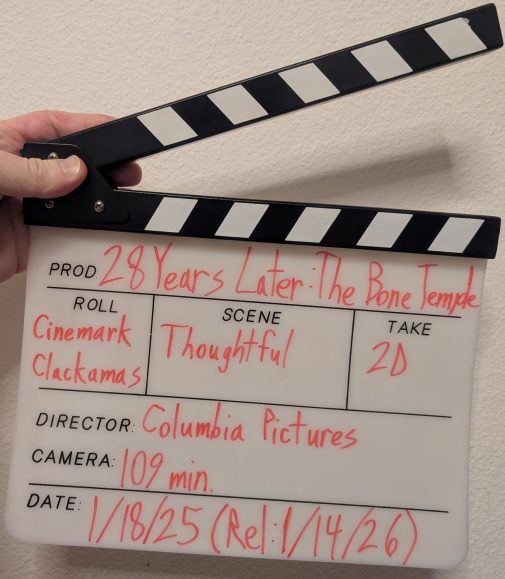
Hm. After a couple decades of waiting, a franchise gets a sequel trilogy. The first and last entries will be directed by the overall franchise mastermind while the second film in between gets handed off to some other visionary director. Where have I seen this before?
Luckily, 28 Years Later: The Bone Temple was helmed by Nia DaCosta, a demonstrably capable talent in the horror genre. I might further add that all three films in this sequel trilogy were written by Alex Garland, so that’ll help with the continuity. And the second film picks up from the first in some neatly clever ways that show impressive foresight, so that helps earn some confidence.
Unfortunately, there’s one huge problem that must be addressed right out of the gate: Spike, played by Alfie Williams. A huge part of what made 28 Years Later so impressive was Spike’s coming-of-age quest in the context of a post-apocalyptic hellscape. In the sequel, Spike does pretty much jack shit. Sure, Spike is still our audience viewpoint character, so he’s there through pretty much the entire movie, but he completely and totally fails to impact the plot in any significant way. Instead, the plot is powered by two different characters running in two separate storylines.
First up is our old acquaintance, the eccentric Dr. Ian Kelson, here played once again by Ralph Fiennes. He’s still covering himself in iodine, still minding his ossuary. Except in this movie, we see a bit more about how pathologically lonely he is, with nothing but old photographs and a record player for company. I might add that Kelson is especially fond of ’80s New Wave, so we get some killer needle drops in this picture.
Kelson’s only other company is Samson (Chi Lewis-Perry), whom you may recall as the Alpha infected that Kelson managed to placate long enough to keep around as a kind of neighbor. Well, after repeated doses of Kelson’s unique sedative cocktail, there are signs that Samson might somehow be regaining his humanity. This leads to the fascinating — and extremely dangerous, for obvious reasons — question as to whether the infected can be treated and returned to human.
This question leads in turn to other intriguing questions. What does the world look like through the eyes of an infected? How would other zombies react to a human who used to be a zombie? Would a human remember what it was like to be a zombie, and would that leave any residual trauma? What would the side effects of such a treatment be like? What if the treatment only half-worked and we’re left with a kind of human/zombie hybrid?
These are all deeply compelling questions, especially since there are so few zombie films out there that have gone anywhere near this territory. I might add that given the franchise’s heavy psychological focus with regard to grief and trauma, and the grey area between human and monster, the angle works surprisingly well in the context of the other films. It’s a shame we don’t get more time to sufficiently explore these concepts, but what we get is both thrilling and fascinating.
The other central character here is Sir Lord Jimmy Crystal, played by Jack O’Connell. As a reminder, this is the guy who models himself and all his disciples after the late Jimmy Savile, an infamous British comedian who was posthumously revealed to be a sexual predator. More importantly, 28 Years Later kicked off when young Jimmy ran into the church only to see his father go stark raving mad, screaming about how the zombies were a sign that the end times had finally come to purge the world.
As explained in this movie, Jimmy had taken this episode as a sign that his father was, in fact, Satan. Which would make Jimmy himself the son of Old Nick and therefore the literal Antichrist. Couple that origin story with Jimmy’s innate charisma, flashy style, and psychotic sense of fun, and we’ve got a perfect recipe for a religious cult.
What we’ve got here is a study in opposites. Jimmy desperately wants and needs the adoration of followers who would kill and die for him, while Kelson is a wise old hermit who more or less lives in isolation. Jimmy’s actions and beliefs are all about making death as painful and humiliating as possible, while Kelson is a doctor who tries to ease his patients’ passing out of a deep respect for death. Jimmy is a Satanist while Kelson is an atheist. Jimmy wants to burn the world down while Kelson holds out hope that the world may yet be cured.
I could go on, but you get the idea. It’s this contrast that powers the climax when the two storylines finally collide. Thus we get a showdown in which Jimmy and Kelson each try manipulating the beliefs and methods of the other. It’s sufficiently entertaining to watch, which is quite a statement for the climax of the film.
Naturally, this approach depends greatly on Jimmy’s followers, all of whom are also named Jimmy. Trouble is, they’re also our victim pool. Which means the characters have to be developed enough to make any kind of decision about what to do in a crisis of faith, but they also have to be flat enough that we can get some measure of guilt-free enjoyment out of watching them die.
The compromise is two-fold. One, we’ve got Spike on hand to be our innocent audience surrogate, trying to hide his simultaneous shock and relief when a Jimmy suffers some gratuitous death. Second, we’ve got Jimmy Ink (Erin Kellyman), the one Jimmy who actively seems to sympathize with Spike, but it’s unclear as to how far that sympathy extends. More importantly, she’s far more loyal to Satan than to Jimmy, which leads to the question of what happens when Jimmy’s lies inevitably come undone.
The end result is that we’ve got one disciple who’s nuanced and developed, with a dynamic relationship to our audience viewpoint character. So she gets to be the deciding vote on the Jimmy/Kelson conflict while everyone else gets to be a good little disposable foot soldier.
Then we have the unresolved plot threads. This is a tricky subject, as it’s tough to know which plot threads may or may not be picked up in the third entry. (By the way, the third movie hasn’t even been scripted yet and we don’t have a release date for it as of this typing.) I might further add that unresolved plot threads are hardly a new problem with this franchise — I don’t expect we’ll ever hear from young Isla again in any meaningful way, and 28 Weeks Later might as well be entirely non-canon at this point.
That said, there’s a glaringly obvious need for a treatment against the Rage Virus. Which makes it all the more frustrating that Samson’s arc is left so open-ended. What’s worse, we briefly meet a pregnant female survivor (played by Mirren Mack) who gets a huge role in an action set piece only to suddenly run out of the film altogether. With no indication of where she went, who she was, or whether she might play some bigger role further down the line. That’s some pretty sloppy storytelling right there.
But of course the major X factor here is exec producer Cillian Murphy. Is there any possibility that he might reprise his role from the original movie? If so, what’s he been doing for the past three decades, how is he still alive, and what could he possibly do that’s interesting enough to justify another movie? Well, Murphy does indeed poke his head in at the very end to tease a few possibilities. That’s all I’m going to say about that, except that the third film had damn well knock it out of the park for everything this movie does to tee it up.
On a final note, fuck the jump scares. The jump scares in this movie are all so annoying and awful, it made me question DaCosta’s talent as a horror director. So damn disappointing.
What we’ve got with 28 Years Later: The Bone Temple is nothing more or less than the middle entry in a trilogy. Yes, it nicely resolves a lot of plot threads and development arcs in a way that retroactively makes the first movie better. At the same time, it plays out in a way that will retroactively look dumber than hell if the third film is anything less than stellar. Either way, the film doesn’t really hold up on its own. Yes, it’s got some neat stuff about religious fanaticism in the context of a zombie apocalypse, but it doesn’t work nearly as well without the first movie to set everything up.
I’m happy to recommend this for those who saw and enjoyed 28 Years Later — especially since 28 Years Later is absolutely worth watching in any case — but nobody else should bother. And if the third movie never comes out and/or tanks, this one is getting banished straight to obscurity.
Well, if the box office opening for this is of any indication, it’s clear how much those audience concerns reflected yours, especially in how this is essentially paying for the sins of the last installment.