
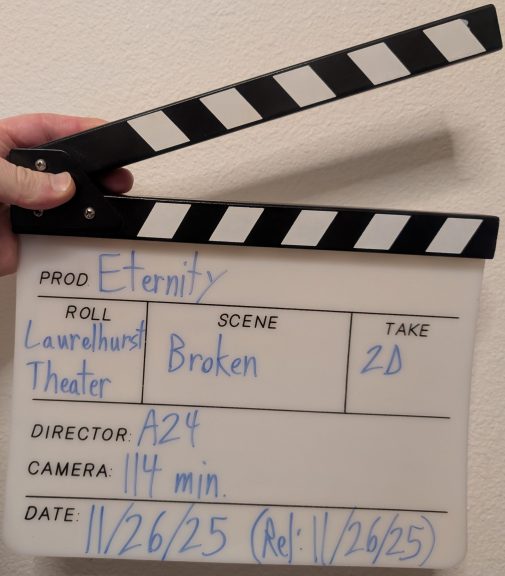
In case the title wasn’t enough to tip you off, Eternity takes place in the afterlife. Which means that huge chunks of the plot and premise are heavily dependent on the world-building and the mechanics of how life after death works in this picture. In turn, this means that the plot and premise will only really be as strong as the rules and how consistent, compelling, or arbitrary they are. So let’s get to it, shall we?
Our stage is primarily set in the Junction, a kind of combination hotel/train station where the recently deceased go immediately after death. So it’s basically Limbo. I might add that everyone who dies gets reverted back to the age when they were at their happiest, so everyone is typically on either side of their teenage years.
Anyway, it turns out that there are hundreds and hundreds of potential afterlives out there. In fact, a great many afterlives have been decommissioned, simply because they somehow got full up or because they were no longer popular. Regardless, there’s a wide range of eternities to choose from, and the Junction is perpetually full of salespeople trying to lure the newly-deceased over to any particular one. It’s left frustratingly unclear as to whether they get some kind of commission or what they’re doing all this recruiting for.
In any case, the catch is that while everyone gets their free choice of eternity (yes, everyone, saints and sinners alike), the choice is permanent. It is literally eternity. No visiting another eternity, no escaping an eternity. Anyone who crosses that threshold is stuck in that eternity forever, along with anyone else who’s there. And the recently deceased only have one week to make their decision.
What happens if the rules are broken? Well, there’s a lot of talk about The Void, a pit of emptiness that’s the closest thing this setting has to Hell, but we never actually see it or get a sense of how bad it really is. And anyone who escapes their eternity is chased down by a couple of thugs who are surprisingly easy to evade. And anyone who takes too long to decide gets downgraded from a really nice hotel room to a hotel room that isn’t quite as nice, but still perfectly comfortable.
…Yeah, this movie has a problem with internal consistency and stakes. But I’m getting ahead of myself.
Exec producers Miles Teller and Elizabeth Olsen play Larry and Joan Cutler, a married couple who grew old together (their older selves are played by Barry Primus and Betty Buckley) until they conveniently died a few days apart. Naturally, they arrive at the Junction and must decide where to spend eternity together. If only it were that simple.
Enter Luke (Callum Turner), the first man to marry Joan, shortly before he got KIA in the Korean War. And he’s been working as a bartender in the Junction for 67 freaking years, waiting for his wife to finally die. So now Joan’s dead and she has to decide which of her two late husbands to spend eternity with. And all three of them can’t go together because Luke and Larry are so intensely and insufferably jealous of each other.
On the surface, it’s a neat premise. Larry is jealous of the dead first husband he could never live up to, and Luke is jealous because Larry got the life he never had with Joan. Larry and Joan had a full lifetime together. They had kids — hell, they had great-grandkids! — and all that time together has meaning. Then again, maybe Joan wants a shot at making memories with her first husband like she never could in life. Of course, a full eternity with either one might be overdoing it.
I like the basic premise. I like the film’s intended messages about grief and moving on. There are some heartfelt statements in here about the nature of love and happiness. I might add that the whole movie looks gob-smackingly gorgeous, and all of the actors came ready to play.
But after we start scratching that beautiful surface, we start getting into some serious problems.
First of all, as I already alluded to earlier, the world-building and the rules at play fall apart under the most basic scrutiny. Granted, this is an insanely heightened premise and any story about the afterlife (especially a non-denominational afterlife without any existing mythology to build from) will always have arbitrary bullshit as a key ingredient. But there comes a point when suspension of disbelief starts to buckle for lack of sufficient internal logic. As the plot unfolds, the various inconsistencies, unanswered questions, and lack of consequences start to pile up until they’re too big to be ignored.
That said, this is an allegory first and foremost. The theme is what really matters here, right? Surprisingly, no. The thing is, this movie wants to be a story about finding a balance, such that our loved ones can be happiest even if we’re not there to share it. This movie wants to be about letting go and moving on, despite all the tempting short-term comforts of nostalgia. But then the ending comes and it actively contradicts each individual theme the film had been developing up to that point.
There’s no getting around it, folks: This movie has a broken plot structure. It’s like the filmmakers didn’t realize they already had a perfect ending all the way back at the start of the third act, so the film drunkenly stumbles around for another half-hour until the runtime finally and abruptly stops. Little wonder the third act is also where so much of the film’s world-building and theme development come hopelessly unglued.
Then again, there’s a big problem with the second act as well. Meet Anna and Ryan, respectively played by Da’Vine Joy Randolph and John Early. These two are Afterlife Coordinators, responsible for guiding their clients through the Junction and helping them find the best possible eternity. Anna serves as the AC for Larry, while Ryan has apparently taken it on himself to be the AC for both Joan and Luke.
It bears repeating that we get no stated motivation for what the ACs get out of this. We have no concrete idea why Anna and Ryan are so aggressively and obsessively set on making sure Joan chooses their client. The best we get is an offhand “golden goose” remark from Ryan, implying that the ACs work on some kind of commission, but we’re sure as hell not going down any kind of rabbit hole regarding how money is supposed to work in the afterlife.
Regardless, the point stands that Luke and Larry each want Joan exclusively for himself, forever and ever, conveniently forgetting the “til death do you part” clause in their vows. Compounding this, Anna wants Joan to pick Larry and Ryan wants Joan to pick Luke, both for their own selfish reasons that we never learn anything about. In summary, everyone here is an asshole! Everyone is only thinking of themselves while poor Joan is stuck with the impossible task of trying to make everyone happy. Despite the fact that everyone else is only after their own happiness with no regard for her.
This is the entire second act, folks. It’s Luke and Larry and Anna and Ryan all desperately trying to upstage each other, acting more obnoxious and annoying and self-centered and petty. The longer this goes on, the less funny it gets. The less romantic it gets. The less intelligent it gets. There seriously came a point when I didn’t care who Joan ended up with. Critical mission failure. Game over, good night, thanks for playing.
Eternity is one of those unfortunate cases in which all the pieces are there, but they don’t fit together. It’s a brilliant premise, the casting is rock-solid, the visuals are all flawless, and there are a few genuinely good themes in here. Unfortunately, the plot is so terribly structured that the pacing is shot to hell, most of the themes are mangled, and the romantic comedy is neither romantic nor comical.
It’s a cute movie, but such an ambitious film of this pedigree in a crowded awards season slot needs to be so much better. Sorry, but I can’t possibly go higher than a rental recommendation.