
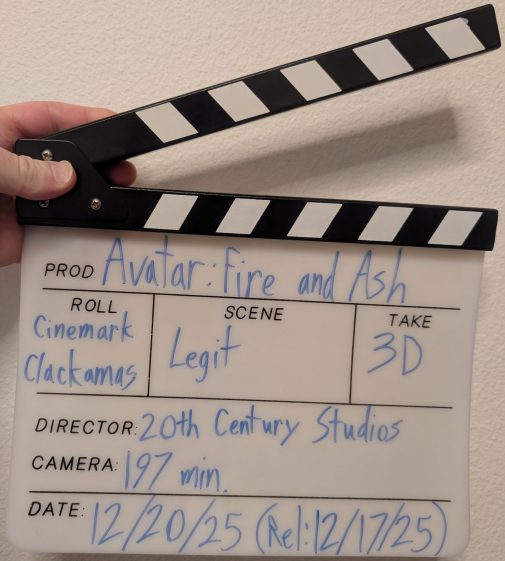
I thought I had this franchise all figured out.
I mean, it’s not like there was much to figure out in the first place. Avatar was dirt-simple to the point of condescending, an overwrought picture with one-dimensional characters and a threadbare plot. Yet the sheer spectacle was so groundbreaking that of course we got a sequel… over ten years later.
When Avatar: The Way of Water finally came, it was basically the same plot with extra steps. Swap out the forest for an ocean, swap in a new MacGuffin, spread Sully’s development arc across his kids, and it’s the same story. Yes, these movies are proof that “basic” doesn’t always mean “bad”, and James Cameron remains the king of brainless crowd-pleasers. (I said what I said — Cameron is the filmmaker that Michael Bay wants to be when he grows up.) Even so, there’s a legitimate concern about how many times the same movie can be repackaged and released.
Well, James goddamn Cameron went and slapped those concerns right out of my mouth.
To be clear, Avatar: Fire and Ash is still very much an Avatar picture. The visuals are spotless. The cast list is unreservedly bloated. There’s three hours of movie for 90 minutes of plot at most. The action scenes are over-the-top and awesome. The ecological themes are simplistic and preachy. Eywa is deus ex machina bullshit. We’ve got villains who are one-dimensionally evil and heroes who are one-dimensionally good.
Speaking as a longtime Avatar hater, everything we all love to hate about the Avatar films is here. But there’s so much else here to like as well.
First of all, the plot picks up a short time after the second film. Which means that the casualties of the last big climax are still fresh. Thus the Sully family (with Jake Sully played once again by Sam Worthington) is still wracked with grief over the recent passing of Jake’s son Neteyam.
We’ve got Jake immersing himself in the war effort to distract from his grief. We’ve got Neytiri (Zoe Saldana) bringing back her old anti-human prejudices, even as she remains married to a former human and all of her (surrogate) children are at least partly-human. There’s Lo’ak (Britain Dalton), the second son who blames himself for the death of his older brother and wants to prove himself as a worthy soldier. And that’s not even getting started on Kiri and Spider (Sigourney Weaver and Jack Champion, respectively), the adopted children who question their place in the family. Hell, given that one of them is the parthenogenic birth of an avatar and the other is the human bastard son of an RDA colonel, it’s worth asking what place they have in Pandora.
Yes, we’ve already got a lot of moving pieces to keep track of, and we’re barely getting started. But the point stands that here in the third movie, we’re finally seeing the characters grow and develop in new and interesting ways. There’s legit character drama here.
Getting back to Kiri and Spider, it’s a pressing and glaringly obvious issue that the Sullys have an adoptive kid who can’t breathe the air on Pandora. Which means that Spider can’t survive without human tech that’s in vanishing supply. Long story short, Kiri pulls some of her mystical deus ex machina bullshit (and not for the last time), so now Spider can breathe the air on Pandora.
That’s the good news. The bad news is that if RDA ever finds out about this, they could reverse-engineer whatever’s in Spider’s lungs. Which means that humans would be free to colonize Pandora without the use of avatars or masks. Whoops.
So, this film’s MacGuffin isn’t some magic rock that powers human tech. And it isn’t some bullshit fluid that makes wealthy humans young and healthy forever (though amarita remains a key motivation for the villains, especially in the climax). This time, the MacGuffin is an actual character who could potentially change everything on Pandora for all sides of the conflict in clear and palpable ways. This is an upgrade.
Then there’s the matter of escalation. At the start of the film, Sully is salvaging weapons from the previous film’s climax. He argues that there’s a war on and the Na’vi need all the ammo they can get. Yet the Na’vi abhor guns and refuse to trade them for arrows and spears. On the one hand, it’s easy to see where Sully is coming from. On the other hand, it’s not like the lack of firearms ever stopped the Na’vi from winning in the previous two films, so whatever they’re doing is clearly working.
More importantly, there’s the implicit expectation of binary morality. If the Na’vi are all good guys, then more guns to Na’vi means more good guys get guns. And sure, that was a pretty safe assumption in the previous two films. Not anymore.
Enter Varang (Oona Chaplin), leader of the Ash clan. Here we have a clan of Na’vi who are pirates, raiders, and homicidal maniacs. Simply put, if the Na’vi of the previous two films were analogous to the modern socially conscious depiction of Native Americans, the Ash clan are the harmful and monstrous depiction common to westerns of the early 20th century and earlier (complete with scalping their enemies).
These are the savages that the humans think all the Na’vi are. The Na’vi that other Na’vi are afraid of. While the other Na’vi are ecological zealots who worship the network of plant and animal life on Pandora, the Ash clan are bullying nihilists who want to turn all of Pandora into the desolate volcanic wasteland they call home.
Are they one-dimensional villains? Absolutely. But the central concept of evil Na’vi is so interesting, and it’s something this franchise so badly needed, we’ll go along with it.
Then there’s the matter of Col. Miles Quaritch (Stephen Lang). Here we have an artificial echo of a man long dead. He was brought back for a short-term mission that remains incomplete, so now everyone’s wondering what he’s still doing here and what’s going to happen with him in the long term. I might add that however much Quaritch may consider himself human, he’s still walking around in a body that’s Na’vi in every way that matters. And it’s starting to have a psychological effect.
The upshot is that Quaritch can never go back to living among the humans, because he’s stuck in a Na’vi body. And he could never go native and betray humanity like Sully did, because his pride won’t let him. But now he’s got a third option: If he joins the Ash clan, he can go native while also burning down Pandora. And he gets a hot horny goth girlfriend (the aforementioned Varang) in the bargain. So of course he goes all-in.
That said, a great many humans remain displeased with the notion of allying with Na’vi. At one point, Sully himself points out that with one tribe of Na’vi fighting each other, the humans can’t tell which blue friends or foes they’re shooting at (which affects the coherence of the battle scenes, by the way). Even better, if the bad Na’vi are allowed access to human facilities and resources, that opens up the possibility that a good Na’vi in disguise could slip in undetected.
Oh, and let’s not forget the human drama. There have been human defectors since the very first movie, and we’re still seeing humans losing faith and patience in the mission, committing sabotage in big ways. Even at the highest levels of command, we get generals and bureaucrats at loggerheads because this whole mess has proven more exhausting than it’s worth.
All of this comes down to one simple and unavoidable truth: Earth and Pandora are starting to affect each other in far-reaching ways. And not always for the better. If anything, the humans and Na’vi have both demonstrably grown greedier, angrier, more paranoid, and more desperate as a direct result of the ongoing colonization.
The first film was centered around an identity crisis, with Sully asking whether he was human or Na’vi and where the boundary rested between those two selves. But now we’ve got Quaritch going native in a darker and more violent way. We’ve got children born on Pandora to human and Avatar parents. We’ve got Spider, a human who’s effectively transforming into a Na’vi. In essence, after two movies’ worth of events, the identity crisis is now playing out on an interplanetary scale.
In turn, this means genuine layers of nuance and depth that this franchise has always desperately needed. Sure, the franchise is still built on a black-and-white binary morality, but there’s now a grey streak in between. And that grey streak gets increasingly wide as the film continues. It’s genuinely compelling to watch.
With all of that said, it’s unavoidably true that the plot leaves a great many threads unresolved. Little surprise, because of course this franchise was built from the ground up for perpetual sequels. That said, there’s a feeling that Jake Sully’s story has been told. Given the way everything plays out, I think he can and should pass the torch to his kids.
With Avatar: Fire and Ash, the franchise has finally proven that it can be more than pretty CGI and ecological evangelizing. I’m sincerely impressed with how this entry wove together so many elements from the previous two pictures while adding in new ideas, all adding up to something genuinely epic that could only be accomplished three movies in. Yes, the bloat is still there and it’s still a problem, but it feels like everyone is finally figuring out how to make the characters memorable and the world worth spending time in. I’m finally convinced that there are more stories worth telling in this setting.
That said, it’s undeniably true that James Cameron is getting on in years, and I don’t think anyone wants him to spend the rest of his life on Pandora. (To wit, he’s been talking a lot about making a new Terminator film.) If this franchise really has grown to the extent that I think it has, it should be solid enough for another filmmaker to come in and take the reins. (The Russo Brothers love James Cameron, they would do it in a heartbeat.)
Ultimately, this is a critic-proof movie. If you haven’t seen the past two movies, you won’t (and shouldn’t) jump on here. If you’ve seen the past two movies (i.e. spent the time and money to watch a couple of three-hour movies that demand the premium big-screen viewings), you’re likely invested enough that you’ve already seen the third one.
It’s extremely unlikely that anyone is still on the fence about this movie, enough that the third film will sway them. But for what it’s worth, I was.