
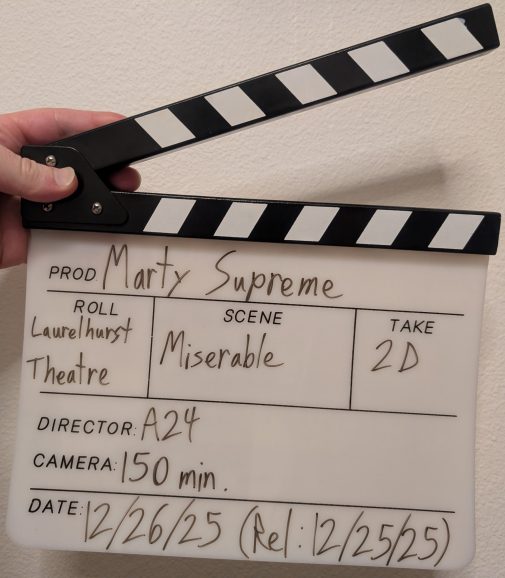
Longtime readers will know that I’m no fan of the Safdie Brothers. I’ve said for years that Uncut Gems is overrated bullshit, and I’ve never been the least bit tempted to revisit Good Time. That said, I could at least respect them. For better or worse, the Safdies full-on commit to making bold and interesting movies about awful human beings.
(Also, Benny Safdie proved himself a delightful actor in the tragically underrated Are You There, God? It’s Me, Margaret and nobody can take that away from him.)
But this year, the Safdies each went their separate ways to bring us two very different sports movies. Benny Safdie went off to do The Smashing Machine, a movie directly and faithfully based on the life and times of Mark Kerr. Meanwhile, Josh Safdie went and made Marty Supreme, a heavily fictionalized story loosely inspired by the late Marty Reisman.
Having seen both movies, now I know why the two brothers need each other. Benny without Josh is cloying and dull. Josh without Benny is ugly and obnoxious.
(Side note: It’s worth noting the involvement of Ronald Bronstein, co-writer and co-editor on the Safdies’ joint projects. Bronstein had nothing to do with The Smashing Machine, but he co-wrote and co-edited Marty Supreme alongside Josh. Make of that what you will.)
When the Safdie Brothers worked together, I hated how every other shot was done in extreme close-up shaky-cam. Turns out Benny was the shaky-cam guy while Josh was the extreme close-up guy. And I guess Josh was the guy with a deep-seated love for ’80s electronica, because we get more ’80s needle-drops in this movie set in 1952. Make that make sense.
Anyway, this is the story of Marty Mauser, played by producer Timothee Chalamet. Marty is a New York Jew, working at his uncle’s shoe store. I hasten to add that we’re introduced to Marty just before he knocks up his childhood friend (Rachel, played by Odessa A’zion), who happens to be married to another man. Not only do we see the extramarital affair, but we also get an opening credits sequence that directly shows Marty’s sperm implanting in Rachel’s egg, thus leaving absolutely no room for doubt as to who the father is. Disgusting, but quite useful.
All of that aside, Marty’s boss/uncle (Murray, played by Larry “Ratso” Sloman) wants Marty to become the manager and inherit the business. Marty would rather be the world champion at table tennis, a nascent international sport that’s already gained massive popularity in Asia. Trouble is, table tennis is still on the fringes in the USA and it’s tough to find anyone who will take Marty’s ambitions seriously. Even so, the far bigger problem is Marty himself.
Don’t get me wrong, Marty is talented. He’s demonstrably a world-class ping-pong player. But he’s still not as good as he thinks he is. He sure as hell isn’t as good as he says he is.
More importantly, while Marty has a talent for table tennis, he’s far more talented as a bullshit artist. Marty is so charismatic and so wrapped up in his own delusions, he could sell pretty much any scam. Now, running away from the people he scammed, that’s the tougher part that keeps coming back to bite him.
Time and again, Marty keeps making promises he can’t keep and breaking things that can’t be fixed. And every time he’s faced with the consequences of his own fuckery, he runs away. And every time he runs away, he burns another bridge and leaves someone else screwed over.
No two ways about it, Marty is a piece of shit. He’s a narcissist, a pathological liar, a delusional self-serving fuckwit who destroys literally everything he touches. He doesn’t start learning his lesson and getting some measure of comeuppance until the third act, and the climax is admittedly compelling. By the time Marty actually gets a chance to compete with his ultimate rival (Japan’s Koto Endo, played by legit table tennis champion Koto Kawaguchi), we’re left wondering whether Marty is competing for money, for pride, for love of the sport, to spite everyone who ever said he couldn’t do it, or any combination of the above.
Alas, it’s far too little and too late by that point. Whatever happens, there’s simply no way that Marty could ever pay all his debts or make amends to everyone he screwed over along the way. At some point in the second act, Marty had so thoroughly sabotaged his own life, his own career, his own family, his own reputation, and every last friendship he ever made, that there was never any chance he was going to get what he wanted. And as soon as that line was crossed, the entire movie was DOA.
That said, Marty is nowhere near the most greedy and unlikeable prick in this movie. We’ve got Ira (Emory Cohen), Rachel’s abusive husband. We’ve got Milton Rockwell (Kevin O’Leary), a one-dimensional hate sink who came into his wealth by making and selling pens (yes, seriously). There’s Ezra (Abel Ferrara), who turns out to be far more dangerous than he appears. We briefly cross paths with a deranged trigger-happy farmer played by an unrecognizable Penn Jillette (of all people!). Every single NYPD cop we see in the film is brazenly corrupt. And then of course we have a full procession of bastards and slimeballs who get hustled out of their money by Marty at various points all through the picture.
Which brings me to the other side of the coin: The collateral damage that Marty leaves in his wake. We’ve got Luke Manley, playing a put-upon friend who just happens to have a rich father. There’s Wally (Tyler “the Creator” Okonma), another table tennis hustler who loses his entire livelihood for his involvement with Marty. Fran Drescher does just enough to cash a paycheck in the role of Marty’s poor mother.
And of course we can’t forget Rachel. The woman who lost her husband to an extramarital affair with Marty. Granted, her husband is an abusive motherfucker, even more than Marty. I might add that she’s known Marty for pretty much her entire life and she’s pregnant with his child. As such, it’s at least marginally understandable why Rachel would cleave to Marty, trying to learn and benefit from his scam artist ways. Sure, she’s nowhere near as good at it, but that’s probably to her credit.
Then there’s Gwyneth Paltrow. She plays Kay Stone — wife to the aforementioned wealthy asshole Rockwell — a washed-up actor from the ’30s trying to revitalize her career on Broadway. One thing leads to another and she engages in an on-again/off-again extramarital tryst with Marty. To recap, Kay is…
- Married (albeit unhappily) to a wealthy and well-connected industrialist
- A significantly older woman with her own accomplishments and responsibilities
- Perfectly aware of exactly what a greedy and dishonest shitheel Marty is
Taking all of this into account, it would take phenomenal chemistry to sell the sexual magnetism between these two characters. And it isn’t there. With all due respect to Chalamet and Paltrow, they’re both wonderful actors, but the chemistry to sell this relationship simply isn’t there.
Overall, I had a miserable time watching Marty Supreme. Two-and-a-half hours is far too long a time to watch this innately unlikeable protagonist ruin himself and everything he touches — even the film itself! For all of Chalamet’s charisma, Marty does too much irreparable damage to too many undeserving characters over too long a time. Even when Marty is outsmarting or screwing over someone who’s even more unlikeable, that minor victory won’t solve anything or help anyone or develop Marty into a character worth rooting for, so it’s not any fun to watch.
I said it before when I reviewed The Smashing Machine and I’ll say it again here: The Safdie Brothers need to get back together ASAP. One writing/directing without the other is useless.
Do you suspect that this film will be every bit as overrated as Uncut Gems in the long term? Especially after it gets all the Oscar nominations next January? I think it’s very easy to interpret this as some fable about the BS the American Dream promises and that the only thing that gave Marty real happiness was being in tears seeing the baby he put in Rachel after coming home from Japan an American “hero” abroad. Guess that’s where the critics were coming from with their praise.
The film is too far up its own ass to make any kind of coherent statement about the American Dream — it’s tough to parse out the morality of the unlikeable characters and their despicable actions in that context. I could totally believe this is a case of mob groupthink, giving undue praise to a film that won’t be anywhere as good or fondly-remembered in hindsight. And I say that with the full knowledge that I can fall for such positive groupthink and have multiple times in the past.