
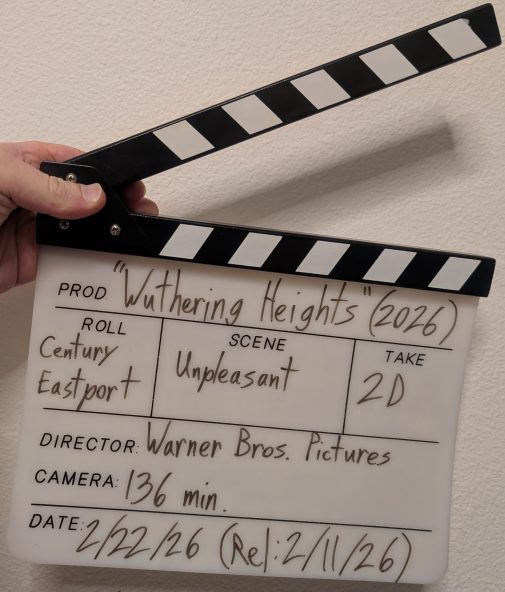
I’ve never actually read “Wuthering Heights”, but that doesn’t feel like it should be an issue. At this point, the Emily Bronte book is such a foundational classic, its influence is felt in every romantic drama made since. “Heathcliff” is a household name, a shorthand for the stoic gothic hunk. Should the female lead follow through and marry the rich asshole or throw it all away and choose true love with the poor chivalrous dreamboat? That question has been the foundation of countless romantic dramas, from “Lady Chatterley’s Lover” all the way to goddamn Fackham Hall.
Thus in terms of story, I felt like I know what to expect from “Wuthering Heights” (2026). For that matter, I know what to expect from producer/star Margot Robbie and costar Jacob Elordi. The big question mark for me was writer/producer/director Emerald Fennell, a filmmaker I couldn’t quite get a handle on. But now that I’ve seen Promising Young Woman, Saltburn, and her latest, I think I’ve finally gotten her figured out. And I kind of wish I hadn’t.
For the uninitiated, here’s a rundown of the story, at least as presented in the film. The eponymous Wuthering Heights is an estate handed down through however many generations of Earnshaws. Unfortunately, the latest Mr. Earnshaw (Martin Clunes) is an abusive, drunken, narcissistic crackpot with a nasty habit of gambling away all his money. Moreover, he’s got a penchant for taking in orphans and bastard children, as a means of cheap labor.
Enter Heathcliff (played as an adult by Elordi), an illiterate young wretch taken in by Earnshaw. He’s quickly befriended by Earnshaw’s daughter, a pretty, conceited, spoiled young brat named Catherine (played as an adult by Robbie). Earnshaw effectively gives Heathcliff to Catherine as a kind of “pet”, never mind that he had already picked up another bastard kid to be her playmate (Nelly, played as an adult by Hong Chau).
Long story short, Catherine and Heathcliff grow up together in the same broken household, with traumatic childhoods under the same shitheel father figure. They tease each other and drive each other crazy in the way that kids do at that age, but there’s still an underlying love between them. Even though Catherine is technically above Heathcliff in station. Then again, given the Earnshaw family’s self-imposed financial problems, Catherine and Heathcliff are actually much closer in social status than anyone wants to admit.
Flash forward to the arrival of Edgar Linton (Shazad Latif), who moved into the next estate over after making his international fortune in textiles. Seizing on the chance to revive her (family’s) fortunes through marriage, Catherine makes herself known and available to Edgar, who promptly makes an offer of marriage. Catherine knows that it would break her heart and Heathcliff’s if she made this marriage for money, but she does it anyway and Heathcliff swears revenge. It’s all downhill from there.
At some point in this movie, I flashed back to Fennell’s other films and had an epiphany. Looking back across all three movies, they all have one crucial thing in common: Everyone is an asshole.
Folks, it’s really kind of impressive and hilarious in a way. “Wuthering Heights” in particular leans hard and heavy into the fact that Heathcliff is a sadistic and self-absorbed asshole. Catherine is an entitled and self-absorbed asshole. Edgar has some justification for being angry about his unfaithful wife, but he’s still a jealous domineering asshole.
His little sister (Isabella Linton, played by Alison Oliver) works nicely as the comic relief, but she’s still a spiteful and stupid asshole. Nelly is primarily there as the voice of reason, but she’s also a vindictive and dishonest asshole. I appreciate having Mr. Earnshaw on hand to illustrate the corruptive nature of wealth and ego, and to demonstrate the crippling poverty that Catherine is so desperate to run away from, but the point stands that he is a one-dimensionally evil asshole.
This is the whole movie, folks. Just like the last two. It’s all about watching unsympathetic and irredeemable assholes destroy each other. And sure, there’s some degree of satisfaction in watching hate sinks give each other their comeuppance, but it’s nonetheless miserable to sit through.
On the other hand, it plays into the themes and plotlines of the story, in a twisted kind of way. After all, while Heathcliff and Catherine are both sick and awful people, they were nonetheless cut from the same cloth. Again, they’re the product of the same awful circumstances, both peasants at heart no matter how they pretend to be nobles.
Catherine and Heathcliff whipsaw back and forth between loving each other and destroying each other, a morbidly fascinating display of how thin that distinction can get. The two of them hate each other and love each other in a way that could only come from a place of intimate knowledge and deep emotional connection. These two irredeemable sacks of shit belong together because they deserve each other.
That’s really kind of sweet, in a sick and twisted kind of way.
There’s another theme in the recurring motif of biology. My favorite example concerns the bedroom of the newlywed Catherine, built with the instructions that it was to be painted in the color of Catherine’s face. And in a psychotic display of mindless wealth and slavish vanity, the decorators painted her face in microscopic detail, with every vein and freckle visible on her bedroom walls. Sure, Edgar loves his wife’s beauty, but he took that to an extent that borders on goddamn body horror.
Right up front, the movie opens with some anonymous man getting hanged for the pleasure of the viewing audience. And particular attention is drawn to the resulting creaks and groans that might be confused for coitus. One kid watching the execution points out the hanged man’s erection as a result of rigor mortis.
Time and again, the film finds all these ingeniously demented ways of showing how life, death, and sex are all different interconnected facets in the greater experience of having a body. It’s honestly quite inventive and darkly comical how the film takes so many aspects and details of biology and magnifies them to an absurd degree.
Which of course brings us to the main selling point of the movie: The visuals. The set design, costume design, MUAH, lighting, shot composition, all of it looks amazing. And the cast is certainly attractive, that helps a lot. I particularly love how the film never settles on orange/blue contrast or red/white/black contrast, but flips between multiple color schemes as necessary. It sure helps a lot to sell the contrast between the squalid Wuthering Heights and the lavish Linton estate. Oh, and of course the original Charlie XCX music does wonders to bolster the atmosphere even further.
Everything about “Wuthering Heights” (2026) — including and especially the gobsmacking visuals — reinforces the point that this is a movie about self-serving assholes destroying each other. That is the movie and there’s really no other reason for watching it. So if you love to watch unsympathetic characters suffering and destroying each other for 140 minutes, here’s your movie. Otherwise, steer clear.