
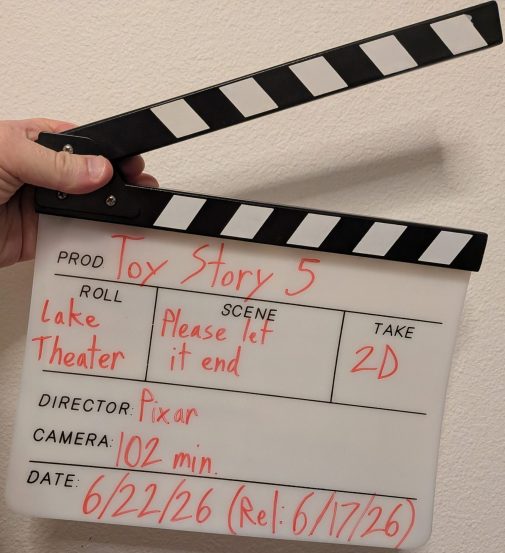
I thought Pixar was getting better. I really did.
Sure, Elio wasn’t a masterpiece, but it was still a sweet little story that wasn’t part of a major franchise. In fact, we should probably all be grateful that the film bombed, so future generations can rediscover this hidden gem and it won’t be tainted by any future sequels. Hoppers earlier this year was another charming and heartfelt little fable that stands perfectly well on its own. That one did much better in reviews and box office dollars, and there’s still no sign (yet) that it’ll be watered down with any further sequels.
To be clear, it’s not like Pixar could never make good sequels. Toy Story 2 and 3 are strong contenders for the greatest sequels ever made. But Toy Story 3 was sixteen years ago, long predating the target demographic. In the time since, we’ve seen The Incredibles 2, Cars 2, Monsters University, Inside Out 2, and of course Toy Story 4. Not to mention the Lightyear spinoff. Not that all of those films were necessarily bad, but none of them were instant classics like Toy Story 2 or anything we got from Pixar back in the day. There’s definitely a sense that the higher-ups at Pixar/Disney have forgotten how to make a sequel that expands and enriches the previous entry without a sense of diminishing returns.
Which brings us to Toy Story 5.
The premise is simple. Bonnie (now voiced by Scarlett Spears) is having trouble making friends, now that all the other kids her age are playing with online screens and bullying her for playing with antique dolls. Thus her parents get her a Lilypad (voiced by Greta Lee), a kid-friendly tablet that lets her play games and talk with other kids on a dedicated social media platform. This naturally causes friction with the analog toys and we’re off to the races from there.
Here’s the problem: We already went through this all the way back in the first movie. The looming threat of obsolescence has been the central underlying core of the entire franchise from Day One. This is just more of the same… on paper. In practice, this is something radically different simply because of the sheer scale involved.
The prior movies were all tightly focused on our main characters. We’ve seen how Buzz’s arrival threatened to make Woody obsolete, something that strangely didn’t seem to worry any of the other characters in the first movie. We’ve seen how the main kid’s advancing age and development threatened to make some or all of the main/supporting characters obsolete. But with the arrival of smart technology for kids, we’re seeing an existential threat for all toys on a planetary scale. The film goes hard and heavy into selling online tech as the potential end for all analog toys everywhere.
But of course this is Pixar we’re talking about here. No way could it be that simple.
First of all, of course the analog toys have to reckon with the fact that their kids will someday outgrow them. And it doesn’t matter when or how they get cast aside, all that matters is that the toys are there for their kids at the time and in the way that they’re needed. We’ve already been over this umpteen times in the previous entries, but at least we get some new perspectives on the old concepts this time.
What’s more interesting is in the trio of “smart” tech toys from the previous decade. The most prominent one is “Smarty-Pants” (Conan O’Brien), a potty-training toy who got put out to pasture just as soon as his human (more on her later) outgrew training diapers. Yes, this unfortunately means an unwelcome amount of potty humor, and you’d think Pixar would be above that. But more importantly, here we have toys that are more technologically advanced than the analog toys we’ve come to know and love… and they’re in the exact same position. They love their kid, they’ve missed so many years in the life and development of their kid, and they were dumped for the newer model just as soon as they were no longer needed.
While the point is never explicitly stated as such, it’s nonetheless perfectly clear that Lilypad won’t always be the shiny new model. Someday, Lilypad will be obsolete and thrown aside just like all the other toys. Moreover, kids have a way of rediscovering things. It’s possible — but certainly not guaranteed — that some kid may fall in love with an analog toy that’s become old enough to be new again. (see: Toy Story 4)
Then there’s the whole “social media” angle. To sum it up as quickly and spoiler-free as I can, the film makes a strong case that social media and online multiplayer games are nothing more or less than the standard social experience writ large. Yes, social media makes it easier and faster to make more social connections all over the world. But more social connections doesn’t always mean more friends. Compliments and insults are all only data, and they all travel at the same high-speed internet connection. When the chips are down, all that really matters is who’s there when you need them.
Furthermore, these online games are built from the ground up to be relentlessly addictive. To the point where players feel compelled to meet up and play at specific times. Even playing solo, there’s this strange psychological drive to keep playing at all times. And if the compulsion is so strong to the point where it feels like a necessity and not like fun — and with no room for the player to create or invent — does that even count as “play” anymore?
There are a lot of genuinely interesting and relevant ideas here. And it’s almost enough to make up for the outrageously weak plot.
Let’s start with the obvious: The film tries to make the case for why we need online tech and how it can be used responsibly. And the film repeatedly undercuts that theme by showing how totally oblivious humans are because they’re all glued to their screens. In fact, it’s made emphatically clear multiple times that the toys can only get away with all the ostentatious shit they pull because humans are too oblivious to notice. I know the bar for suspending disbelief has always been high with this franchise, but it stretches all the way up to the stratosphere every time something happens that would make any rational human sit up and take notice.
Then there’s Jessie (an audibly aging Joan Cusack), who gets sent back to the address of her pre-Andy owner. It’s a laughably ridiculous plot contrivance. But it does bring us our obsolete tech characters, introduces a potential friend for Bonnie (Blaze, voiced by Mykal-Michelle Harris), and it got us a gut-punchingly tear-jerking moment out of it. So at least that could be justified.
But then we’ve got the situation with Woody, because of course we had to get Tom Hanks involved. Trouble is, he contributes nothing. Yes, he helps to sell the global stakes of the tech toy invasion, but we already got that with a Jessie scene shortly before. And at no point in the entire movie does Woody do anything or think of anything that Buzz couldn’t have done on his own. Which means that Woody’s involvement does not in any way justify the walkie-talkies that somehow popped up in between movies so that Woody and Jessie could call each other in a pinch.
But then we have Buzz, voiced once again by Tim Allen. Good gods above, where do I even begin with Buzz?
First off, this movie finally takes the step of following up on Buzz’s infatuation with Jessie, first established all the way back in the closing minutes of Toy Story 2. So now Buzz has been appointed Jessie’s deputy, a job he takes deathly seriously because he intends to finally propose marriage to Jessie and he’s aggressively jealous of anyone who might try to jeopardize that proposal. Which in turn leads to umpteen shouting matches between Buzz and Woody as the astronaut persistently gets in the cowboy’s way at every turn. It’s a pathetic substitution for the friendly rivalry that Buzz and Woody have had since the first movie.
(Side note: If you’re wondering about the logistics of marriage between toys, let’s remember that Mr. and Mrs. Potato Head have been an item since the second film. Just go with it.)
But then we have the army of Buzz Lightyears. A literal crate full of Buzz Lightyear toys — equipped with all the latest and greatest in Wi-Fi and drone technology — fell off the back of a metaphorical truck and busted open. So now we’ve got a platoon of Buzz Lightyear toys — all under the delusion of being actual Space Rangers, just like Buzz was in the first movie — running around until they stumble into the main plot. Just in time to solve all the characters’ problems for them. This is laughable. Embarrassing. Disgraceful. This is transparently bad plotting to such an extent, I didn’t even think Pixar was capable of such incompetence.
What makes it even worse is that we shouldn’t even need 50 Buzz Lightyears. Not when we’ve got just as many supporting characters — all with different personalities and skill sets — established over the four previous movies. Back in the first three entries, the filmmakers would’ve tried to build a climax out of Slinky Dog’s ability to stretch, Mr. Potato Head’s detachable limbs, Hamm’s carrying capacity, and so on. But there’s no such effort or creativity here. Instead, we’ve got a few dozen copies of Tim Allen coming down like a fleet of deus ex machinas.
Trouble is, there are now simply too many supporting characters to keep track of. The mere act of getting all the established voice actors into the booth would take an Avatar-scale budget and a world-class Ouija Board. Thus — with the exceptions of Buzz, Woody, and Jessie — all of Andy/Bonnie’s toys spend pretty much the entire film in a box in the garage. The iconic Pizza Planet aliens barely show up. Bunny and Ducky show up for a hot second, but they never say a word because Key and Peele weren’t there to voice them.
The frustrating thing about Toy Story 5 is that it’s not outright bad. The heart that always defined this franchise is still in full effect here, and I genuinely appreciate what this movie has to say about online screens and the kids growing up with them. The problem is that there’s not enough of that here. And I know that because the film had to pad the runtime with so many extraneous storylines and poop jokes and convoluted plot shenanigans simply to get to 100 minutes.
It sucks that every sequel keeps introducing a new batch of characters, to the point where the original characters are only given lip service and nowhere near used to their full established potential. (Though again, it’s a factor that most of the original cast is either dead or dying.) And it sucks that Pixar isn’t crafting their scripts and action sequences with the creativity we’ve come to expect from them. Hell, a correspondent of mine pointed out that Lilypad’s arc here is an exact duplicate of Anxiety’s arc from Inside Out 2. I don’t know if I’d agree it was an exact duplicate, but it’s close enough.
What sucks most of all is that we’re never getting a worthy capstone to this saga. There will never be a conclusion worthy of what the series deserved, because we blew right past that all the way back in Toy Story 3. Given the encroaching age of the voice actors and the dearth of worthwhile ideas in this picture, it’s abundantly clear that it’s only going to be diminishing returns from here on out. It sickens me to see the franchise going out with a whimper like this, but here’s where we are.
I can give this one a home video recommendation. But honestly, the better thing to do would be to let life imitate art. We had Toy Story when we needed it, and now it’s time to let it go and hope for better luck with Gatto next year.