
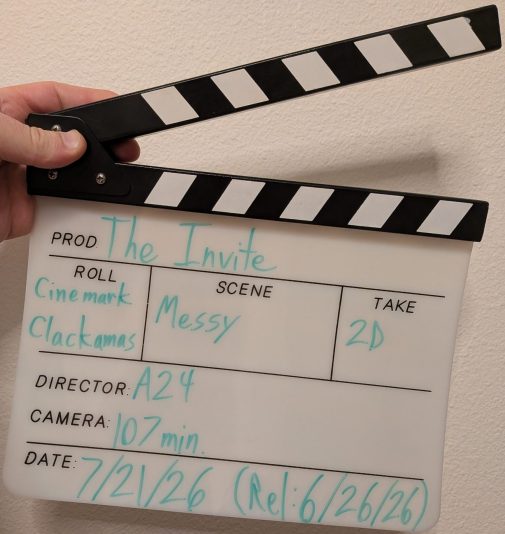
Back in 2019, Olivia Wilde decided to take her acting bona fides and try a pivot toward directing feature films. Her first attempt was Booksmart, and it was awesome. Her second attempt was Don’t Worry Darling, which stepped on more rakes than I could possibly catalogue here.
With The Invite, it appears that Wilde has finally found her sweet spot as a director. Looking back over the three films she’s directed so far, it becomes readily obvious that Wilde is at her most capable with intimate character drama, not so much with epic scopes or huge set pieces. Unfortunately, the script came with its own set of problems.
This is an adaptation of The People Upstairs, a Spanish film from 2020, written and directed by Cesc Gay, which he in turn adapted from his own stage play. In the past six years, the original film has already been adapted into a Swiss film, an Italian film, a French film, and a South Korean film. Even this American take has gone through a rocky adaptation process, starting out with a totally different cast under the husband/wife directing team of Jonathan Dayton and Valerie Faris. After the Guild Strikes of 2023, development more or less had to start from scratch.
By all appearances, Will McCormick and Rashida Jones (who are not a married couple) were the credited writers from start to finish. But with such a long and bumpy road from a foreign-language stage play to the finished onscreen product, there’s no telling how many conditions the script went through. I might add that considering the actors involved, the slipshod editing on display, and all the weird rambling between characters, it’s tough to guess how much of this dialogue was improvised.
We lay our scene in the San Francisco apartment of Joe and Angela, respectively played by Seth Rogen and Wilde herself. The two of them are married with a young daughter (whom we never meet), but it’s quickly obvious that their marriage has some glaring communication issues. Joe is a failed musician, half-heartedly teaching music at a crappy charter school. Angela is a former painter, but she’s apparently given that up so she can stay at home and renovate the apartment. No joke, there’s one point in the film when Joe himself asks his own wife point-blank what she does for a living.
Anyway, Angela’s deal is that she’s all about appearances. She’s all about maintaining total control so she can keep up the illusion that everything is fine, even when it isn’t. Contrast that with Joe, who’s much more open and honest about how everything sucks. And the both of them have a nasty habit of taking their frustrations out on each other.
Enter Pina and Hawk (Penelope Cruz and Edward Norton, respectively), the upstairs neighbors who have a notable habit of indulging in such loudly enthusiastic sex that they tend to keep Joe and Angela awake at night. Angela takes it upon herself to invite the neighbors downstairs — and she may or may not have told Joe about this in advance, it’s hard to tell with their aforementioned communication problems — so the two couples can get to know each other and air out their differences.
Let’s pause and take stock of the four actors we’ve got here. Olivia Wilde. Penelope Cruz. Edward Norton. Seth Rogen. One of these is not like the other. One of these does not belong. If you didn’t already know that Rogen can’t act worth a damn, it’s never been more obvious than when he’s stuck in a room with three world-class actors. Yes, he’s a comedian, so he can hold his own as an improv performer and riff off the other actors in humorous ways. Otherwise, he’s not playing a character so much as he’s going through the exact same shtick we’ve seen umpteen times in all his umpteen other movies.
Anyway, what we’ve got here is an exercise in “cringe humor”. Joe and Angela are deeply uncomfortable about everything to do with their current situation. They’re lying through their teeth to try and be the perfect hosts to these two strangers, and Joe doesn’t care enough to try and keep the lies straight.
In short, this is a film about petty bullshit, in which thoroughly unlikeable characters go through every scene yelling at each other and making their own problems over not a damn thing. It’s deeply unpleasant and unfunny to sit through. But then we cross the half-hour mark and a fascinating thing happens.
Joe gets a moment alone with Pina, which leaves Hawk alone with Angela, and there’s suddenly better chemistry between neighbors than between spouses. Right up until all four are back in the same room together and we’re right back where we started. Until the next big plot twist.
I don’t mind spoiling this, because it’s rather crucial to the plot and the trailers have more or less given the game away: Hawk and Pina are in an open relationship. Their lovemaking is so noisy because they have multiple people over for orgies on a regular basis. And they came down to see if Joe and/or Angela would be open to joining them in bed at some point.
Thus the back half of the film is an exploration into consensual non-monogamy. Obviously, this is something Joe and Angela need considerable effort to wrap their heads around. Here’s the thing, though: I live in Portland. I’ve read “Polysecure”. I’ve got a social group loaded with friends in polyamorous relationships. None of this stuff was particularly shocking or comical to me, though I do recognize that I’m pretty far ahead of this particular curve. And while I can’t speak for anyone who’s actually in the lifestyle, I will say that nothing in here struck me as particularly offensive or invalid, so there’s that.
Something else worth noting is that there isn’t really much in the way of sex or nudity in this movie (though the discussions get particularly graphic). It’s the emotional connection that really matters here. This whole exploration into CNM is primarily important as part of the greater discussion about how something is seriously wrong with Joe and Angela. They’re both miserable, their marriage is doing more harm than good, and something has to change. That’s not to say divorce is necessarily the best way forward, but it’s a near-certainty that Joe and Angela do not have what it takes to salvage their wedding on their own.
Maybe they need a friend. Maybe they need a neighbor. Maybe they need a therapist. It’s not exactly clear what they need. But their unorthodox neighbors can maybe help with some trial and error to figure it out.
The Invite is a frustrating mixed bag. There are some genuinely good ideas in here, with some neat character drama and welcome discussion about consensual non-monogamy. The problem is that it comes buried in so much petty bickering and banter. Huge swaths of this movie are deeply unpleasant to sit through, totally worthless and unfunny. Of course, it doesn’t help that Seth Rogen is out of his weight class by a damn sight. I might add that the notion of Rogen in a romantic/sexual polyhedron with Olivia Wilde and Penelope Cruz is the most transparently ridiculous matchup I’ve ever seen.
(And I remember when Sharon Stone and Sofia Vergara called up John Turturro for a threesome. Fading Gigolo, look it up. Better yet, don’t.)
A while back, I reviewed 5 to 7, an arthouse movie nobody saw about an open and unconventional marriage. In retrospect, that movie from 2015 was too far ahead of its time — the following decade of trial and error made a huge difference in developing the polyamorous community and best practices regarding the lifestyle. It was certainly a better-made movie, but The Invite is a more thorough examination of CNM, its pros and cons, how to practice it ethically and safely, etc.
Overall, I have a difficult time giving this one a pass when there’s so much else going on in theaters right now. It might be worth a home rental if you’re curious about CNM, but simply reading “Polysecure” would be the healthier, more informative, and honestly more entertaining option. I know Olivia Wilde has a better movie in her, and I know there’s a better movie to be made about CNM — hopefully, this film will be a useful stepping stone to getting us both of those movies.