
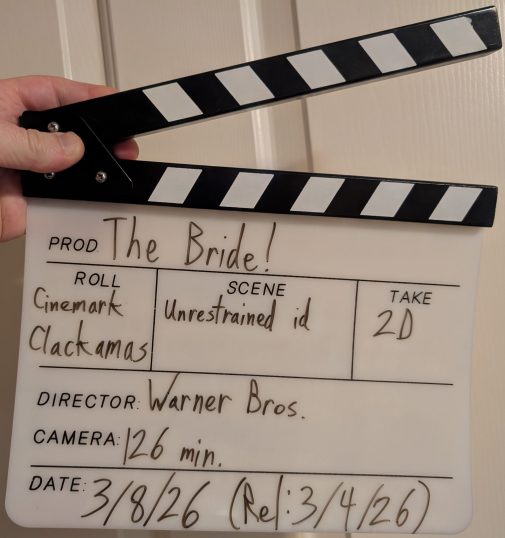
The Bride of Frankenstein did not appear in the original Mary Shelley text. Frankenstein starts work on a female mate for his original creature, but scraps it partway through, and that’s all we ever got. Until The Bride of Frankenstein in 1935, easily one of the all-time greatest film sequels. The Bride herself is only one of a great many iconic Frankenstein moments that didn’t come from the original book or the original film, but came from the cinematic sequel.
Yet the Bride herself doesn’t actually appear until the climax. And she never appears again. No sequels, no spinoffs, no crossovers, nada. One of the most iconic monsters in the entire fabled Universal Monsters canon, with a grand total of two minutes’ screentime. The movie is that damned good. And the character is that damned interesting.
Leaving aside the novelty of a female monster in this style and time period, there’s something innately fascinating about the notion of exploring the story’s classic existential themes through a feminine lens. (The original author was a woman, after all.) Back in 1985, Franc Roddam attempted to give The Bride her own movie — as portrayed by Jennifer Beals — with Sting and Clancy Brown respectively playing Frankenstein and his original creature. Pity that movie bombed, and the Bride deserves so much better.
So here we are with The Bride! a loose reimagining as written/directed/produced by Maggie Gyllenhaal (complete with her husband and her brother in the cast). This is Gyllenhaal’s sophomore directing effort, after the overhyped misfire that was The Lost Daughter. Though she did at least reteam with Jessie Buckley, who was easily the best part of that movie and has only grown as an actor in the time since. And she’s the eponymous Bride alongside Christian Bale as the Creature, which is even better.
Little wonder the film came out to such a mixed reception, because this one is all over the place. Even trickier, it’s messy by design.
Right off the bat, the film bills itself as a direct sequel to the original story, with a setting in 1930s Chicago. Which isn’t as far out there as it sounds. Who’s to say Frankenstein’s creature (we’ll call him “Frank” for short, as the characters do) couldn’t have lived so long and found his way to Chicago eventually? But that’s not the weird part.
The weird part is that the film positions itself as a direct sequel to the original story… as written by the original author. Yes, Mary Wollstonecraft Shelley herself appears, as played by Jessie Buckley (carrying on the tradition set in Bride of Frankenstein).
It seems that the filmmakers were resolutely set on the notion that this was the sequel Shelley most desperately wanted to write, but simply never did. It’s a neat idea. At the same time, the filmmakers wanted to explore what Frankenstein and his bride would be like in a time when talking pictures were starting up, pop culture was new, and the concept of undead monsters was beginning to crystallize. Hell, the original Dr. Frankenstein existed in this canon as a century-old figure of urban legend. That’s also a neat idea.
Here’s the problem: The film is set in the 1930s. Shelley died in 1851.
To try and square this circle, the filmmakers open the film with a meta device, such that Shelley’s ghost is reaching out from beyond the grave, now that she’s finally found the strength and the voice to tell the story she really wanted to write all those years ago. Even better, the Bride (also played by Buckley, remember) is here portrayed as a self-insert character for Shelley. Hell, she’s not even a self-insert, The Bride is literally possessed by the ghost of the author, frequently and directly talking with Shelley over several dream sequences.
Folks, this is too much convoluted batshit for a Frankenstein adaptation to deal with, and we’re not even a minute in.
Anyway, the plot begins with Frank, who’s still pathologically lonely after wandering the world for a century. He’s been searching everywhere for some other misfit medical genius who might be willing and able to replicate Frankenstein’s work and build a mate for him. At long last, he finds Dr. Cornelia Euphronious (Annette Bening), a mad scientist who reluctantly agrees to go along with the project. Thus they dig up and revive the aforementioned Bride.
Trouble is, it bears remembering that shortly before she was killed by a particularly gruesome fall down some stairs, the Bride was acting erratically and hearing voices (Mary Shelley’s, to be specific). So she was an unstable schizophrenic to begin with, and getting brought back from the dead hasn’t helped matters.
To put this as simply as I can, the Bride is pure id. She talks and acts with no mental filter. She has no sense of self-preservation (I mean, she already died once…) and no sign of empathy for anyone else, outside of her developing romance with Frank.
On the one hand, this makes for an unhinged and inherently unlikeable protagonist. On the other hand, this makes the Bride an embodiment of women who refuse to sit down and shut up and look pretty and do what patriarchal society tells them to. Frank was already a misfit too strong and strange and potentially violent to have a place in society, and the Bride exemplifies that to a psychotic degree, with a much bigger chip on her shoulder in the bargain.
For the filmmakers, all of this is a feature. As to whether or not it’s a bug, reasonable minds can disagree.
In point of fact, there are a few moments when Frank is portrayed as a subtly toxic gaslighting boyfriend up until he finally has to reckon with that in the climax. Other times, Frank and the Bride are portrayed as folk heroes, as so many downtrodden women remake themselves in the Bride’s chaotic image. It’s like the filmmakers saw everything Todd Phillips did wrong with the Joker movies and tried to do it right, and that’s commendable in a way.
The problem I keep running into is that I worry the filmmakers lost themselves in their own ideas. On paper, I get the appeal of using this character to talk about women, the mentally ill, sexual abuse survivors, and everyone else that mainstream society typically marginalizes. I genuinely like the idea of reinventing the Bride as a monster that celebrates and humanizes the unusual and the exploited. But when it’s done by way of a film that’s deliberately oddball to the point of impenetrable, I’m not sure that’s doing the intended job.
It’s hard enough that we’ve got so many interludes in which the Bride talks with Mary Shelley’s ghost, reinforcing this meta narrative that makes no goddamn sense and has no place in the story. (In fact, if the Bride only discovers her inner rebellious strength because the Voice of God urges her to, doesn’t that directly undermine her own autonomy and character growth?) But then we’ve got all these dance sequences that blur the line between fantasy and reality in such a way that it’s hard to tell what’s going on.
By the way, one of those dance sequences is set to “Puttin’ on the Ritz”. And the “Monster Mash” plays over the end credits. For fuck’s sake.
Then we’ve got the Ronnie Reed subplot. See, because Frank can’t directly sing or dance or socialize with people, he lives out those fantasies through the musical films of celebrity actor Ronnie Reed (Jake Gyllenhaal). Inevitably, this leads to a moment when the superfan personally meets the superstar and gets humiliated. In theory, it’s a neat new perspective on the theme of loneliness, and it makes perfect sense that Frank would latch onto pop culture as a potential outlet for his social problems. In practice, it’s a good idea taken too far. There are way too many scenes of Frank and the Bride inserting themselves into unrelated black-and-white films and the subplot quickly outlives its utility.
Then we have the detectives. Peter Sarsgaard and Penelope Cruz play a couple of detectives following the trail of dead bodies left behind by Frank and the Bride. The basic gist is that while they’re both good at what they do, and they both have a healthy respect for each other, nobody else ever listens to the female detective. Again, it’s a neat idea. The problem here is that the exact nature of the relationship between the two of them is left frustratingly vague. We have no idea if she really is his secretary or his wife or whatever else — they tell so many lies on the subject that the truth is frustratingly elusive. It’s tough to chart the characters’ growth and development because the baseline is so shaky.
Oh, and there’s another subplot about a mob boss. Totally unnecessary. It probably would’ve done more good if that whole storyline had been cut entirely.
Kristen Stewart recently said that anyone can direct a movie if they have something to say. The Bride! proved her wrong. Gyllenhaal had a great many things to say with this movie, and she couldn’t get out of her own way long enough to make any one coherent point. She fell into the classic blunder of making a crazy movie about crazy people. Her protagonist is unrestrained id, and her entire movie is unrestrained id. And it’s not like that couldn’t have worked, but it’s a high-risk/high-reward maneuver that’s beaten more talented and experienced filmmakers.
This movie looks and feels like the product of a single auteur who never had to worry about anyone saying no. It desperately needed another writer, another director, another editor, another producer, anyone who could trim the excess and hone the movie down into something leaner, meaner, and more coherent. Case in point: Somebody seriously should’ve sat Gyllenhaal down and explained to her that a woman who died in the 1950s has no business being in the 1930s and that goddamn Mary Shelley meta-narrative should’ve been shitcanned after the first draft!
Ultimately, I respect this film far more than I like it. It’s certainly a unique and memorable film, and I appreciate the intended messages. And of course I would always rather see a movie that fails for too much ambition rather than too little. But I’m sorry, Maggie Gyllenhaal simply isn’t ready to be a writer/director. One or the other, maybe, but not both. Not yet.