
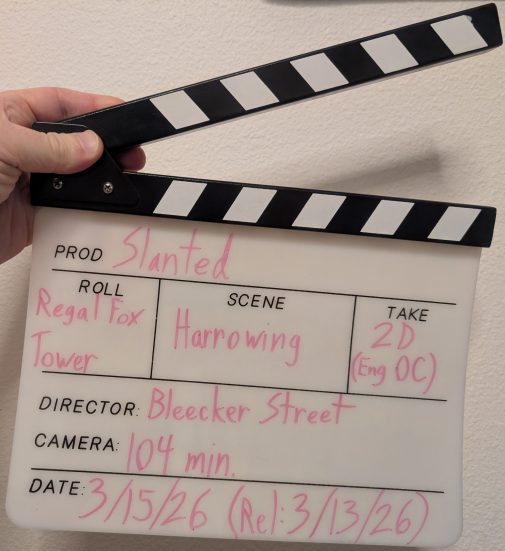
A couple years ago, we got a little film called The Substance. It was a feminist work of body horror, made and marketed as a scathing satire of show business, patriarchal beauty standards, etc. There were numerous reasons why that movie took the world by storm, foremost among them that it was really goddamn good.
So here we are with Slanted, a feminist work of body horror that takes a satirical look at many of the same body image topics… with a racial twist. Yes, writer/director/producer Amy Wang (here making her feature debut after a slew of short films and TV projects) brought us a movie built around the premise of an Asian young woman who struggles under the white cis-hetero patriarchy, and thus turns herself white.
Let’s get to work unpacking, shall we?
It’s not explicitly stated where the film takes place, except that it isn’t California. What’s known is that it’s a grotesque parody of the USA, such that every street corner is plastered with jingoistic depictions of young blonde women, the Founding Fathers, the American flag, bald eagles, etc. There’s a storefront for a business called “Prayers & Ammo”. No joke, most of the film takes place at a high school where the students are “the wizards”, and their mascot is dressed like a goddamn Klansman!
This is a place where white privilege reigns supreme, and it’s all too wealthy and extravagant to be anywhere in the flyover states. Based on certain context clues, I’d guess this would have to be Miami or Tampa or somewhere else like that in southern Florida. But I’m already putting more thought into that than the filmmakers probably did.
Anyway, this is the story of Joan Huang (Shirley Chen), a young Chinese immigrant who grew up in Mandarin-speaking household. Trouble is, she also grew up in the aforementioned white nationalist hellscape. So, Joan is raised to be a perfect little Chinese girl at home while she’s treated like an Asian stereotype everywhere else. She wants to be voted Prom Queen — i.e. considered beautiful and worthy and American by her peers — but that’s never going to happen because everyone else only sees her race.
(Side note: I feel compelled to mention that Chen was also a standout performer in Didi, another coming-of-age masterpiece that dealt with many of the same topics and themes.)
Enter Ethnos (spearheaded by Dr. Singer, played by R. Keith Harris), a biotech company that developed a new surgery to permanently turn BIPOC people white. At the halfway point, Joan taps out and reinvents herself as Jo Hunt, now played by McKenna Grace. It’s all downhill from there.
Right off the bat, we’re dealing with a heightened, absurdist, satirical setting quite similar in tone to The Substance. The difference is that literally everyone and everything in The Substance was heightened and two-dimensional by design, to illustrate the superficial and outrageous nature of Hollywood culture. By comparison, the BIPOC characters in this movie — including both iterations of Joan/Jo — have layers and pathos and complicated feelings about learning and living in a culture dominated by people who don’t want to think about race.
Simply put, what we’ve got here is a film about a young woman trying to maintain her identity and sanity in a world run by superficial crackpot honkies. I’d wager half the USA is familiar with the notion.
Our protagonist is a young woman stuck with the classic immigrant dilemma of getting caught between two different worlds. Between the Chinese family pressures at home and the American family pressures everywhere else, she can’t really fit in anywhere. Her mind has been warped by so many different mixed messages of what she should be that she can’t figure out who or what she really is.
Her parents (played by Vivian Wu and Fang Du) are so willfully ignorant of what their daughter is going through that they try to keep her as a case of arrested development without any regard for what she could potentially be. It’s a genuinely fascinating and heartbreaking scene when Joan’s parents are finally and forcefully reminded of what it was like when they first immigrated, and put under so much pressure to conform.
As for Joan’s school life, her peers are primarily led by Olivia Hammond, played by Amelie Zilber. Since Olivia got cast in a TV show (allegedly — apparently, there’s been no official announcement), she’s unable to campaign for prom queen, which means Joan and every other girl in the school is chasing after her endorsement, which will in turn lead to a surefire win. Trouble is, Olivia — as with every other white person in this movie — is a vapid, self-absorbed, superficial asshole that’s only interested in anything to the extent that it benefits them. They don’t have friends, they have lickspittles and social media followers. Everything is only skin-deep to them, most especially with regards to race.
As a direct result, Joan was raised by this society to take on a warped view of race. For her, race really is only a skin color that she was unlucky enough to be born with. Hell, her Chinese heritage and culture aren’t even skin-deep, they’re more like garments she only puts on at home and leaves behind whenever she walks out the door.
But then she’s turned into a white girl. And a great many interesting things happen.
First of all, there are a number of side effects that give us our body horror effects for the movie. In terms of gory visuals, it’s not much. But as a metaphor for Joan/Jo’s ongoing racial identity crisis, the side effects are fantastic.
More importantly, it turns out that white people do indeed have a kind of culture of their own. Not that Joan could’ve known any of that, always being stuck on the outside, but she does have to learn a whole new set of customs and lingo if she’s going to fit in. Trouble is, if she ever does, then she’ll only be another pretty white blonde girl like everyone else, with nothing to make her unique or noteworthy.
It’s right there on the poster, and the line is frequently repeated throughout the film: “If you can’t beat them, be them.” That one sentence alone deserves its own blog entry, there’s so much to discuss.
First of all, it speaks directly to the frustration that’s common among those who feel they can never get ahead or break even in a system rigged against them. So yeah, it sounds like it would be nice to simply flip a switch and join the ruling class. The trouble is, there are a number of logical fallacies built directly into this bargain.
A big one is the assumption that there’s any kind of conflict at all. This doesn’t have to be a zero-sum game. It’s a fascist and racist ideology to maintain a hierarchical system in which nobody can win unless some people lose, or vice versa. Sure, that’s the system we have under the current white nationalist late-capitalist system, but it doesn’t have to be that way.
Alas, this is the system that Joan was born into. She learns that the hard way when she first turns into a white girl and — to her surprise — all the other white girls immediately try to bring her down in the interest of asserting dominance. She wasn’t even on the ladder before, and now she’s on the lowest rung. But at least she’s got a shot at climbing up the social ladder, even if that means beating down everyone else. We’ll come back to that in a minute.
Another fundamentally mistaken assumption is a misunderstanding of racism itself. Racism is a beast that cannot be fed. As presented in the film, giving up one’s racial identity to join or placate the white neighbors is effectively the same as surrendering to white supremacy. Thus making it even more pervasive and oppressive against other BIPOC people. (See also: The American Society of Magical Negroes)
Ethnos and its proponents talk a great deal about equality, and how it can never be possible so long as race is a factor. Trouble is, there’s a difference between equality and conformity. It’s a matter of how to build a world where everyone is both equal and different. I need hardly add that Joan/Jo and her peers are constantly trying to change themselves to keep up with the arbitrary whims of others who don’t care about them or even know that they exist. That’s always a losing battle.
Which brings me to what might be the single most powerful moment in the film. See, a central part of why Joan goes through the surgery is because she’s tired of white people discriminating against her and treating her like garbage. And then she becomes a white girl. Who has that same power over black and brown people. And she doesn’t really put two and two together until she’s under pressure to double-cross Brindha (Maitreyi Ramakrishnan), the best friend character who’s probably the one and only person in this whole cast who completely and unconditionally loves and supports Joan.
I won’t spoil exactly what happens between Joan and Brindha. Suffice to say that when Jo is put under social pressure to dehumanize brown people like she and her parents have been dehumanized all their lives, it’s an internal conflict with astronomical stakes.
Time and again, in the back half of the film, Jo is repeatedly faced with the same challenge: “Prove that I can trust you.” Her whole identity as a white girl is built on delusions and lies, and even a few outright felonies. In short order, the lies and secrets pile up so quickly that nobody can tell fact from fiction. Olivia and the other white girls can’t trust her. Jo’s parents can’t trust her. Jo can’t even trust herself. So when Jo has to pick an allegiance and do something drastic in the interest of proving her allegiance, things quickly spiral even further out of control.
Folks, I’m only scratching the surface of everything going on with Slanted. While the body horror element is scant enough that gore fanatics may be left wanting, the basic race-swap premise is far more effective as a rich identity metaphor. There are so many layers here with regard to immigrant life, the American dream, the nature of white privilege, racial identity, growing up as a BIPOC teenager, predatory body image standards… folks, it would take at least another two or three viewings for me to properly dissect and document everything going on here.
The setting is alarmingly broad, but it’s anchored by rock-solid performances and deeply sympathetic characters. Not to mention the fascinating internal and external conflicts powered by genuine pathos. Amy Wang proved herself an extraordinary writer/director with such a bold debut.
It’s a film that makes effective use of its scant budget, with thoughts and ideas far more harrowing and palpable than so many gallons of latex. This one gets a strong recommendation.