
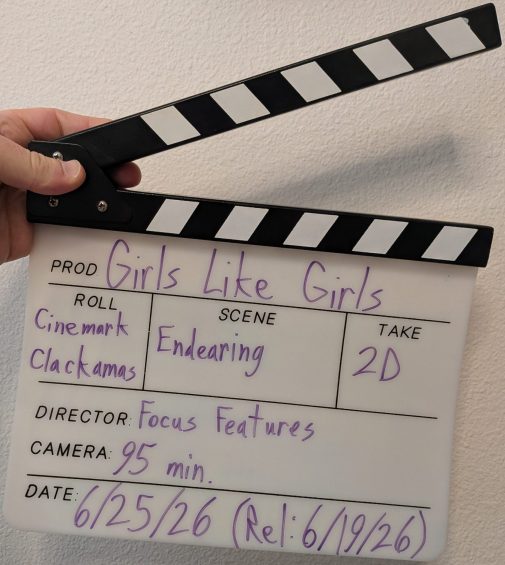
I could never get into Hayley Kiyoko’s music (I’m more of a Rina Sawayama guy, myself), but I recognize and respect Kiyoko as a queer icon of modern pop music. Ask anyone about modern queer anthems and “Girls Like Girls” will inevitably come up. Kiyoko didn’t just co-write and perform the song, but she also co-directed the music video. And then she expanded the song into a novel while also voicing the main character in the audiobook.
Naturally, the next step was for Kiyoko to make her writing/directing feature debut with Girls Like Girls, a film adaptation of her novel based on her song. For extra measure, she brought along two co-writers. The story was co-written by Chloe Okuno, a journeyman film/TV writer best known for her 2022 directorial debut, the stunningly underappreciated Watcher. Sharing credit on the script is Stefanie Scott, a young actor/singer with a long list of credits in various genres (horror, most especially), and she happened to be the star of the original “Girls Like Girls” music video.
And what did we get? Well, we got a feature debut from someone who’s spent the past ten years exploring the same story in different media. Remember how well that worked out for Backrooms? That’s pretty much how well it worked out here.
We lay our scene in some rural Oregon backwater, the kind of place where everybody knows each other and the local kids have nothing better to do than hang out at the local pond and be assholes to each other. Naturally, I can’t make any kind of heads or tails as to which Oregon town this is supposed to be. And the film was shot up in Canada, so that’s no help.
The year is 2006, that awkward transitional time when we were all making do with AIM and flip-phones until social media and smartphones could be invented. It was also a transitional moment for the LGBTQ+ community, in that awkward time when queer folk were rapidly gaining social/cultural visibility, but without any of the political clout or mainstream acceptance that would come with the Obama years. (Remember, this was the age of Brokeback Mountain.)
As the title states outright, this is a story of two closeted gay teenagers. Sonya (Myra Molloy) is a relatively straightforward case. She’s a social butterfly, queen bee of her friend group, an overachieving athlete with a bedroom full of trophies to please her overbearing parents… you know the type. Except she doesn’t have a boyfriend. She has a toxic macho shitheel with delusions of controlling her (Trenton, played by Levon Hawke — yes, Ethan and Uma’s other kid), but Sonya makes a clear point of saying that she’s “emotionally unavailable” for enigmatic reasons.
Our protagonist is the other girl. She’s a tougher nut to crack.
Nicole (though she prefers to go by “Coley”, played by newcomer Maya de Costa) recently moved in from San Diego, shortly following her mother’s untimely passing. It’s not explicitly clear exactly what she died from, but all signs point to suicide. So now Coley has moved in with her dad (Curtis, played by Zach Braff), even though the two of them haven’t been on speaking terms since her dad walked out when she was still young. We’ll circle back to that later.
To recap, Coley is dealing with (1) a mother who took herself out of the picture, leaving Coley with (2) the father who ran out on his kid and his wife, putting Coley in (3) a town she doesn’t know full of kids she doesn’t know, and also (4) she’s a budding homosexual with so many romantic/emotional/sexual urges she doesn’t know what to do with.
Put it all together and this poor girl is pathologically lonely. She’s been broken and traumatized by abandonment issues, practically conditioned to believe that nobody will ever love her. Oh, and did I mention that the local boys in town are bullying sex-addicted assholes?
So naturally, Coley decides to play it safe and be a quiet little wallflower. But then she meets Sonya. And something magical happens.
While Coley is a prisoner of her own social anxieties, Sonya is a prisoner of her own social expectations. In both cases, they desperately want to be something else — something they don’t have a name for, and there’s nobody in their friends or family who can help them figure it out. The end result is that when Sonya and Coley are alone together, they’re uniquely free to drop all their walls and be themselves. They effortlessly trust each other, such that they can say anything or do anything… to a point.
There’s this endearing back-and-forth between Sonya and Coley, as they discover themselves and each other in the process of testing the boundaries of whatever relationship they have. It’s sweet and spicy how the two of them push each other physically, emotionally, and spiritually until one of them finally reaches the breaking point. And that’s where things get really interesting.
Remember, while they both need something deeper and more real, the fact remains that Sonya’s got so many superficial friendships while Coley doesn’t have any. Sonya has a reputation to uphold while Coley has none. Sonya’s got so much to lose while Coley’s got nothing to lose. Thus Sonya feels compelled to lie to herself and Coley and others (the underage drinking is a frequent and convenient excuse), while Coley can only plow ahead with full-throated honesty. This ends about as well as you’d expect.
Which brings us to Blake (Alexa Mareka). Here we have another local queer girl who seems perfectly fine with entertaining Coley in those times when she and Sonya are on the outs. Granted, there’s a sense that Blake is more of a social pariah, but it’s not like Coley’s any stranger to that and God knows the other local kids weren’t doing Coley any favors. Also, Blake is more openly gay and she’s way more open to having sex.
On paper, it seems like a good match. In practice, hooking up with a social pariah only reinforces Coley’s loneliness when outgrowing it is what she really needs. Speaking of which, while there’s a sense that Blake wants someone to have sex and do drugs with, Sonya wants the kind of validation that could only be found with Coley. Sure, Coley and Blake want each other, but they don’t desperately need each other the way Coley and Sonya do.
And then there’s the matter of Curtis. Here we have a father and daughter who never got to know each other, stuck together under the same roof until Coley’s a legal adult, which should only happen in another year or so. Yet for however short a time, Curtis is solidly resolute in making up for lost time, being a good father and taking responsibility for his kid, even though he has no idea how. It certainly doesn’t help that Coley has so much grief over her mom’s death, and resentment for the father that left her, compounded by all the frustration and heartbreak she’s going through, and she’s taking all of that out on her dad because there’s nowhere else for all that pain to go.
Coley and Curtis both need to heal. They both need to grow. But Coley keeps dredging up the pain and anger and heartbreak because it’s all she knows and it’s easier to stay there, even as it makes moving on harder. But then comes that miraculous moment in the third act when Coley finally does start to grow. She starts to find her place and her people and some cause for optimism that everything will work out… just in time for Sonya to come back into the picture.
It’s a good thing the Coley/Curtis/Sonya triad is so rock-solid, because the rest of the supporting cast is just kinda there. I kept waiting for Trenton to step up as a major antagonist, but his story arc just kinda fizzles out. Likewise, it feels like most of the huge Coley/Blake moments happened offscreen, thus Blake is sadly underutilized. And literally everyone else in the cast might as well have been replaced with cardboard cutouts.
On a final miscellaneous note, I was rather intrigued with the emotional heft that got put into certain items of clothing. In particular, there’s a choker necklace that neatly symbolizes the Coley/Sonya romance. But the main attraction is a denim jacket that Coley finds in her mother’s things. Tracing the backstory and trajectory of that jacket is quite intriguing.
What it comes down to with Girls Like Girls is that if you’re not going to do anything new, you’d damn well better do it right. There’s nothing in here that’s particularly groundbreaking or surprising, but it’s all searingly poignant and brutally sincere. This was the work of a freshman filmmaker who came ten toes down to deliver her message on her terms. And anyway, it’s a queer coming-of-age romance — if all this film had was an overabundance of heart, that would still be enough.
I’m happy to recommend this for a big screen viewing, but I think this one is gonna find its audience on home video. Considering how much of queer cinema is heavily coded (I Saw the TV Glow), explicitly erotic (Portrait of a Lady on Fire), or just plain weird (The People’s Joker), there’s definitely a niche for a cute little romantic drama that’s clearly and unmistakably about a same-sex romance, but sweet and heartfelt and accessible enough for a late-teens audience.