
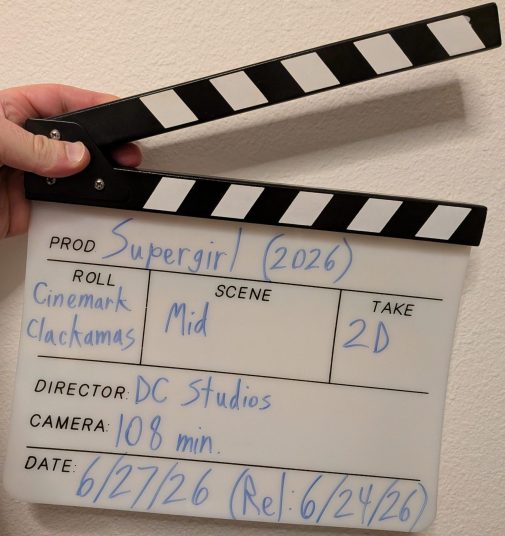
I’ve said for years that the trailer shows you the movie the studio wishes they had. Looking at the trailer for Supergirl (2026), one thing becomes immediately clear: The studio wishes that James Gunn had directed this one too.
Alas, Gunn was too busy trying to start the new DC megafranchise on the right foot with Superman (2025) before going on to make the fast-tracked sequel. So instead, this one was made and heavily marketed as a Craig Gillespie film. You know, the guy who made Cruella and Dumb Money. With all due respect, Gillespie is a journeyman. He’s a competent filmmaker with no style of his own — exactly the kind of director you hire to imitate someone else’s style.
Trouble is, we’ve all seen Avengers: Infinity War. We remember what happened when somebody else tried playing with Gunn’s toys. Predictably, that’s about how well it went this time: Not godawful, but not quite right either.
I want to be emphatically clear, film is not wholly void of merit. Milly Alcock turns in a dynamic performance playing Kara Zor-El. Her origin story with the City of Argo is beautifully depicted. The character’s jaded nature, deep-seated trauma, snarky sense of humor, and gradual steps toward a semi-heroic redemption are all there and all wonderful.
As an added bonus, the film points out that when Kara’s home city was enclosed in a force field and separated from the exploding planet Krypton, the city took a huge chunk of kryptonite with it. Thus Kara had to watch her parents and the entire city slowly decay and die from kryptonite radiation poisoning. As if kryptonite exposure didn’t hurt enough, now Kara’s got that extra bit of PTSD layered on top. Ingenious.
Alas, the film does stumble a bit with regard to Kara’s no-kill rule. Specifically, she doesn’t have one. The trailers should’ve already made it perfectly clear that Kara has no problem killing waves of generic disposable thugs. The problem here is that from start to finish, Kara keeps on telling her unwitting sidekick (more on her later) that murder is a bad idea, revenge is self-defeating, and trauma only begets more trauma. And this is coming from a character who’s perfectly fine with doling out capital punishment herself. There was absolutely a way to make that work, but the filmmakers have neither the subtlety nor the intelligence in trying to find it.
Speaking of no subtlety, Jason Momoa barges in halfway through in the role of Lobo. The character contributes pretty much nothing except for snark and mayhem, but at least it’s fun to watch. Moreover, Lobo makes it clear that he doesn’t kill for sport, he doesn’t kill for revenge, he’s only out for the bounty. That makes for a neat contrast, in a film that so dearly tries (and fails) to talk about the morality and ethics of violence.
Which brings us to Ruthye Marye Knoll, played by newcomer Eve Ridley. Here we have a young woman whose entire family was slaughtered in front of her for no reason at all. So now she’s out for revenge and in over her head. She’s headstrong and naive, with a strong sense of honor that fuels her obsession with vengeance. Though at least she has the courage to stand up for her convictions and confront her trauma, which is something Kara could learn from.
The long and short of it is that Ruthye gives Kara someone to rescue, and a sounding board for Kara’s internal drama. Thus Ruthye provides a convenient means for Kara to learn how to be a superhero. It works well enough.
But then we have the main antagonist. This is where we run into major problems.
See, what makes Gunn’s films and characters work so well is that his heroes are scrappy fuckups, while his villains are tyrants with the madness and the power to reshape the world to fit their concept of order. That doesn’t work here, partly because Kara isn’t really a fuckup. She’s fucked up, sure, but she’s not really a fuckup.
More to the point, Kara isn’t fighting against generals or kings or anyone with any kind of power or ambition. She’s fighting against common thieves and human traffickers. Superman gets to fight kaiju and superpowered henchmen on the way to confronting a deranged supergenius billionaire with political connections and advanced technology to literally destroy the planet; and Supergirl is fighting against pirates and raiders without much in the way of special powers or technology.
I can’t sufficiently express how Kreb of the Yellow Hills — our Big Bad for the movie — is so… hopelessly.. boring. Even with Matthias Schoenartes playing him, the character is so thinly written, so unremarkably bland, so buried in lazy costuming and drab makeup that no actor on Earth could’ve salvaged this. Any Green Lantern would crush this guy and all his goons inside of five minutes. Hawkgirl could take them all down in an hour. Put them all in freaking Gotham and they wouldn’t last a day!
Everyone in the audience knows perfectly well that any full-blooded Kryptonian should be perfectly capable of crushing these idiots with no effort whatsoever. In fact, that’s exactly what we came here to see!!! But no, Supergirl doesn’t get to cut loose until the climax. And no, that’s not because she’s wrestling with her inner demons or figuring out how to use her powers responsibly in a way that lets her peacefully live among fragile mortals (like her cousin).
No, Supergirl is consistently held back due to plot contrivances. Sure, it works well at first — the red sunlight that lets Kara drown her sorrows in booze is the same red sunlight that opens her and Krypto to fatal injury while preventing them from any superheroics. That’s all well and good. But then the film has to find all these contrived means of weakening Kara and keeping her away from yellow sunlight until the plot-convenient moment. And even in those times when Kara does get a halfway decent fight scene, the result is either incoherent (that botched teleportation gimmick) or completely offscreen (the bar fight).
But then the film jumps the shark, with the revelation that Kreb somehow got his hands on kryptonite arrowheads. After it’s been firmly established in Superman (2026) that kryptonite is rare to the point of borderline-nonexistent. And how could some petty no-account crook get his hands on that much kryptonite so quickly? And why would anyone weaponize kryptonite when it would only ever be of use against a dog, a drunkard, a guy who never leaves Earth, and precisely nobody else in all the cosmos?!
Supergirl (2026) lands in that awkward place where it’s just good enough that we can see what the filmmakers were going for, yet bad enough that it doesn’t actually succeed at any of those goals. A character of Supergirl’s immense power needs a worthy adversary, and the lack of one is a fatal error. We needed an antagonist who could push Supergirl to her physical, mental, emotional, spiritual limit, and all we got was a nonentity who hides behind different colors of sunlight. Pathetic.
It’s like the filmmakers didn’t have any faith in their title character, which is strange, considering that Milly Alcock proves herself perfectly capable of delivering a character with far more layers and emotion than the filmmakers could bother with. She and Jason Momoa both turn in performances worthy of a far better movie. Here’s hoping they both get their chance, and let’s hope that Gunn/Safran learned a valuable lesson in hiring directors.
What we’ve got here is a sophomore slump. It happens. This is absolutely not a disaster on the scale of BvS (never mind Morbius or Madame Web or anything else from that accursed tree), it’s only a mid-level disappointment on the scale of The Incredible Hulk. There’s every reason to believe that the fledgling DC cinematic megafranchise can recover from this. As to whether they’ll get that chance with whomever finally buys out WB, time will tell.