
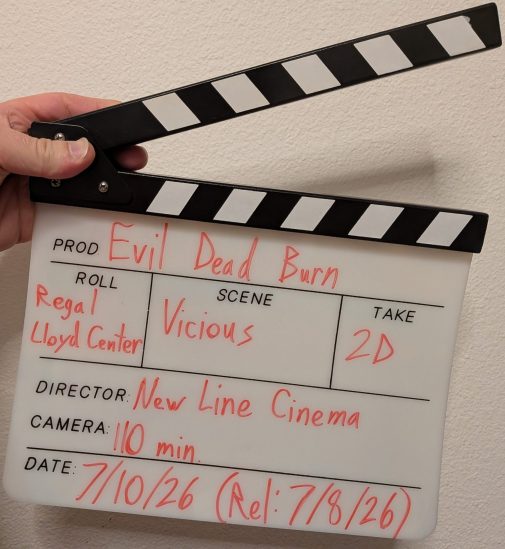
In 2013, Fede Alvarez and the original franchise creators attempted an Evil Dead soft reboot. This new take offered a whole new slate of characters taking on the Deadites in a film fueled by modern sensibilities and legitimate pathos. In hindsight, the film was remarkably ahead of its time.
Back then, the fans weren’t ready to accept an Evil Dead entry without Sam Raimi behind the camera or Bruce Campbell in front of it. That was before “Ash vs. Evil Dead” ran from 2015 through to 2018, putting a firm and final capstone on the franchise’s run with the original creators. This cleared the way for the trilogy of Evil Dead Rise in 2023, the new Evil Dead Burn, and the upcoming Evil Dead Wrath, set for 2028.
So far, each film in the “new generation” goes further and further down the path first blazed by the 2013 effort. Each film takes place in a different setting, with a different cast of characters taking on the Deadites in different scenarios. Thus it’s the Deadites who are now the centerpiece of the franchise, without any one character or actor to anchor the series like Bruce Campbell did. Sure, that makes for a weaker emotional through-line, but it makes the series more versatile and flexible.
More importantly, the new generation keeps doubling down on the Deadites as an emotional, psychological, spiritual threat and not merely a physical one. Sure, the franchise has always been known for its gross-out horror, and the past few movies have certainly not been shy about gory dismemberments. And yes, psychological torment has been a part of the series ever since we first saw Ash and his friends getting taunted and tortured into madness.
Even so, the characters of the first Evil Dead were a pack of one-dimensional co-ed archetypes. When Raimi tortures his characters, he does it in a broadly demented and cartoonish manner. With each successive film in the reboot era, the filmmakers keep drilling deeper and deeper, giving us more sympathetic and more dimensional characters.
They touch on themes like drug addiction, mental illness, unexpected pregnancy, generational trauma, domestic violence, ongoing grief, and so on. The modern Deadites aren’t juvenile bullies going after the victim pool, they’re ruthlessly manipulative demons who are going after the audience! I don’t even care if this focus on deeper third-rail themes takes away from these movies as escapist entertainment, it makes the monsters so much more evil and it keeps the franchise relevant. This is what gives the franchise its own identity apart from other horror franchises, and it’s what makes the Deadites unique from all the other breeds of zombie.
So what’s the story this time? Well, the plot to Evil Dead Burn kicks off with the discovery of a Kandarian dagger, a weapon capable of one-shotting Deadites. But there are two problems. First, of course it’s discovered by some poor dumb schmuck (Joseph, played by Hunter Doohan) who doesn’t know or believe what he’s got. Secondly, the Deadites know about this discovery, so now they’re on their way to recover the dagger before it can be used against them. In fact, the catalyst is Jessica (now played by Greta Van Den Brink), the very same Deadite who kicked off Evil Dead Rise.
Long story short, it’s Joseph’s big brother (Will, played by George Pillar) who first gets infected and dies. Of course he doesn’t stay dead for long, but the next of kin don’t know that yet. Thus we have our plot, in which a grieving family are stuck in a middle-of-nowhere house, with the Deadites picking them off one by one. I hasten to add that the house is all but literally falling apart, for reasons so transparently thin I won’t even bother dignifying them here.
Before moving on to the rest of the victim pool, I should point out that one of the victims is a dog. Yes, this entry features a Deadite dog. The dog dies in this movie. He dies multiple times, on camera, in graphic and bloody detail. CONTENT WARNING.
That aside, it makes the most sense to go in descending order by age. Polly (Maude Davey) is Will’s maternal grandmother. She’s a woman too old, too demented, and too senile to know her grandson is out of grade school, much less dead. Obviously, her loss of faculties makes her an easy mark for the Deadites to manipulate. It also makes for an effective turn when she suddenly becomes competent and/or undead.
Polly’s daughter is the family matriarch. Susan (Tandi Wright) is a woman single-mindedly and pathologically obsessed with the notion of family. Her head and heart are so full of grief over Will’s passing that there’s no room for anything else. She seriously doesn’t care if her relatives are alive or undead, just so long as they can all be together. In all likelihood, Susan doesn’t even care if she or anyone else survives because she doesn’t want to live now that her firstborn son is gone. You can imagine how the other characters take that.
Susan’s husband is Edgar (Erroll Shand), our resident hate sink. A domineering bully who puts everyone in their place with a snarl and a threat. You know the type.
I’ve already mentioned Joseph, the hapless putz who wants everyone to play nice, but he’s too much of a coward to stand up to anyone in his family. By contrast, his wife (Tina, played by Luciane Buchanan) is a more effective diplomat because she actually has a functioning spine.
Which brings us to Alice, our de facto protagonist, played by Souheila Yacoub. She’s a French immigrant who married Will shortly after they met in culinary school. Trouble is, we see at the outset that Will and Alice were on frightfully volatile terms. As the film unspools, we see that their marriage was in fact outright abusive. Thus Alice is left with a great many conflicting feelings about Will’s passing and how to move forward without him. Feelings that she can’t discuss with the rest of Will’s family, because everyone desperately needs to keep on pretending that Will was a saint and his memory must be honored and so on and so forth.
This is what I was talking about earlier with regards to the psychological torture. From start to finish, for 100 solid minutes, it’s nothing but the characters trying to navigate a gauntlet of suffering. Yes, we get some solid jump scares. Yes, the gore effects are inventive, gut-churning, and outright transgressive.
But — and I can’t possibly stress this enough — it’s the mental/emotional/spiritual trauma where this movie excels. At all times, and in every possible way, this movie succeeds in finding new ways for the characters to inflict hard-hitting and everlasting trauma unto each other. And sure, it’s always unsettling when that’s coming from a Deadite, but it’s something else entirely when the humans are sniping at each other just as viciously!
So, are there any nitpicks? Quite a few.
First of all, this is yet another movie in which a climactic scene is shot in a long extended take, tightly focused on the main character, while all the spectacular action is happening somewhere out of frame or in the background. Yes, I get that this is an effective technique for putting us in the character’s headspace while also cutting down on the budget. But watching a sequence like this so soon after Supergirl (2026) did the same thing only proves that this is getting old. There comes a point when this stops being clever or effective and starts being lazy.
Far more importantly, it’s perfectly clear that this is a movie far more interested in what’s scary or what’s emotionally satisfying, as opposed to what makes plausible sense. To be clear, I understand how that sounds in reference to this franchise, in which foul-mouthed zombies from Hell are the main selling point and continuity has only ever been a polite suggestion at best. But when this movie is so wildly inconsistent about how Deadites infect other people or what it takes to kill a Deadite, that’s kind of a big fucking problem. Especially considering the knock-on continuity effects it has on other films in the series.
Case in point: That post-credits scene. (Not the mid-credits scene, the post-credits scene.) I get that the filmmakers wanted to somehow acknowledge Evil Dead Rise, but the way they went about it makes not a single lick of any goddamn sense. And I know they didn’t do it to set up the next movie, because Evil Dead Wrath will be set in 1972. So seriously, what the fuck is this shit?!
Oh, and speaking of nods to the previous films, of course they got the obligatory nod to Bruce Campbell in there. Of course there’s no possible way that could’ve been Ash Williams, but Campbell got a nod.
On the surface, Evil Dead Burn is a perfectly solid movie that blends grisly body horror and psychological torment with deeper emotional issues, merging the sensibilities of ’70s schlock and modern horror, like only the modern post-reboot Evil Dead could offer. That said, the film has a nasty habit of ignoring logic or consistent world-building for the sake of a powerful emotional beat or an effective scare. That’s only a minor annoyance in a stand-alone film, but in a greater franchise, it shows blatant disregard for previous entries and reckless negligence for downstream effects on future sequels.
Yes, I get that the original Ash Williams trilogy rebooted itself with each entry. That was confusing enough back then, though it might’ve helped that so much time passed in between movies. But in the 21st century, in a post-MCU landscape, with only two or three years in between entries, that shit is not gonna fly. Raimi, Tapert, and the other producers in charge of this franchise need to make some firm and final decisions about what the rules are and what the canon timeline is.
My advice: Go see the movie and stay for the mid-credits stinger. And until such time as some later entry explains what the hell is going on with that post-credits stinger, let’s all pretend it never happened.