
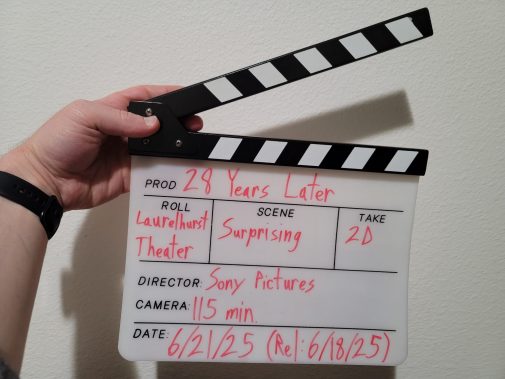
I did go back and revisit the previous two films before seeing 28 Years Later. I needn’t have bothered. The first film is so self-contained, such a pedestrian zombie apocalypse flick, it’s beyond me why anyone thought to make this a franchise aside from sheer profit.
(Side note: Yes, I know this franchise prefers to call them “infected” with the insistence that they’re not “zombies”. Fuck that noise. They’re zombies and everyone knows it.)
28 Weeks Later is even worse. The basic thrust of the film is the discovery of a couple kids who might be the key to curing the virus. But then the film ends with an epilogue showing the plague has spread to Paris — and from there, almost certainly to the rest of Europe and the world. Which means the plague was never cured and the entire preceding plot was thus rendered moot.
Oh, and 28 Years Later opens with a text crawl explaining that mainland Europe has been safely cleansed and the virus is now exclusively contained to the UK Which means the second film might as well have been scrubbed from canon entirely for all the lasting effect it had. And hell, it’s not like the first movie had much in the way of world-building or overarching impact to begin with.
That said, it’s frankly depressing how well the first film has aged. I know I’ve said in the past that there shouldn’t be any nostalgic media from the godawful decade of the ’00s, but I severely underestimated how much worse the ’20s would be. It’s deplorable how this fascist post-COVID hellscape has us looking back at the fascist post-9/11 hellscape. But I digress.
The bottom line is that whether you’re a franchise faithful or a total newcomer, 28 Years Later will play out exactly the same. We open at the time of the zombie outbreak, with a room full of young children getting mauled (yes, that’s seriously how the movie opens), there’s a title card, cut to 28 years later. There’s no continuity with the previous two films, everything you need to know fits into a title card, and everything else plays out exactly the same as in every other post-apocalyptic zombie movie you’ve ever seen.
We lay our scene on Lindisfarne, a tidal island in the UK. It’s only accessible by a long and razor-thin land bridge that can only be crossed at low tide. As such, the island has proven quite resilient against the zombie horde, and the inhabitants have developed a thriving community. One that’s reverted back to Stone Age technology while the world outside quarantine is still online, but even so.
All things considered, it’s impressive how there’s a pocket of post-infection UK that’s achieved some measure of normalcy and security. There are people growing old and raising families, even raising grandchildren. There are kids on that island who make it to adolescence without ever personally witnessing a zombie or an infection. By now, there’s an entire generation who never knew a world without zombies. Hell, in the UK, that same generation has no idea what a smartphone or even a radio is.
Which brings us to our young protagonist.
On this island, one’s first trip to the mainland — i.e. first zombie kill — is considered a rite of passage. This is typically done around age 14 or 15, but Spike (newcomer Alfie Williams) is pressed into taking the errand at age 12. This is naturally due to his father (Jamie, played by Aaron Taylor-Johnson), who seems particularly overzealous in hyping up his son to be some heroic zombie slayer.
As for Spike’s mother (Isla, played by Jodie Comer), she’s suffering from some kind of early-onset dementia, but she’s impossible to diagnose because nobody left has the requisite medical expertise (never mind the equipment). However, there are rumors of an eccentric former physician (Dr. Kelson, played by Ralph Fiennes) carving out a place for himself on the mainland.
Having lost all faith in everyone else on the island (long story) and proven his ability to survive in the post-infection wasteland, Spike takes his mother and runs away to try and find the doctor. And we’re off to the races.
All of that aside, what about the zombies? Well, some of the older stragglers by now have decayed into “Slow-Lows”, bloated corpses that crawl along and subsist on whatever worms and bugs they can find on the ground. They may be slower than the typical infecteds, but they’re quiet, which makes them a whole different kind of dangerous.
Conversely, this movie also introduces “Alpha” infected. These are zombies that must have been athletes or bodybuilders or something in their previous lives, because the ones we see in this picture are goddamn beasts. I must admit, it raises the stakes nicely to have a couple of dedicated antagonist zombies that take multiple shots of heavy artillery to put down.
There’s another intriguing zombie development far too spoilery for me to discuss here. But the other point of interest is how every last infected in this picture is totally naked. One imagines that their clothing would’ve long since worn off in the past three decades. And it’s not like heat or cold or bumps or bruises or mass amounts of dirt ever bothered them anyway.
But as with all the best zombie flicks, it’s really all about the human drama. In this case, it’s about Spike.
To recap, what we’ve got here is a film set three decades into a post-apocalyptic future. But we’ve still got a young protagonist who grew up in a loving family and a tight-knit community, leaving the comfort of everything he ever knew. In effect, what we’ve got here is a coming-of-age story in a zombie setting.
As the plot unfolds, Spike comes to learn that his parents are fallible humans. He comes to learn that the world is so much bigger and more complex than his home. He learns about mortality and grief. Watching this boy go through so many mental/emotional milestones in the context of a zombie apocalypse is genuinely fascinating. And in the hands of these filmmakers, equal parts creative and heartwrenching.
Alfie Williams deserves a ton of credit for anchoring this film, but the entire cast is firing on all cylinders. Taylor-Johnson brings so many layers to what easily could’ve been a one-dimensional character. Jodie Comer’s portrayal of mental instability is simply captivating. Ralph Fiennes delivers a deep well of compassion and dignity under a quirky facade. Hell, Edvin Ryding deserves credit for his brief yet funny and insightful turn as an embodiment of the world outside quarantine.
So, are there any nitpicks? Well, the pacing is a little bit wonky, simply because there’s so much going on with Spike’s coming-of-age development and all the pieces have to be given their due with only a two-hour runtime. And I wasn’t particularly fond of the action scenes, particularly with regard to the pattern of emphasizing every zombie kill with speed-ramping and multiple camera angles — that presentation wore out its welcome quickly.
Most importantly, this is — as it’s always been with this series — a quintessentially British movie. As such, there are a number of montages and background details that will likely resonate far more with a British audience. The most prominent example is easily the final scene, which doubles as a sequel tease that got crowbarred in at the last minute.
Those last few minutes are tonal whiplash. If anything, it only proves that making a series out of this was a bad idea. Even so, I’m aware that a sequel to this movie is somehow in the pipeline, with Nia DaCosta directing. I’m skeptical about a non-British actor taking the reins of such an inherently British series (because they tried that already and look how it ended up), but if DaCosta is on board, then so am I.
Aside from my overarching gripes about the franchise as a whole, 28 Years Later is nonetheless a damn good movie. I know that coming-of-age tales set in the post-apocalypse aren’t necessarily anything new (“The Last of Us”, anyone?), but this one works beautifully well. The cast is uniformly fantastic to watch, and I love the ingeniously poignant development arc of a boy learning how to cope with death in a world that’s grown blase toward it. And while I hate the speed-ramping multi-angle kill shots — and hell, I didn’t even get started on the quarantine patrol that’s literally too stupid to function — the action/horror scenes are nonetheless quite harrowing.
Making a whole trilogy out of this might’ve been a bad idea — and time will tell on that one — but we’ve got a solid standalone film in the meantime. Give it a look.